

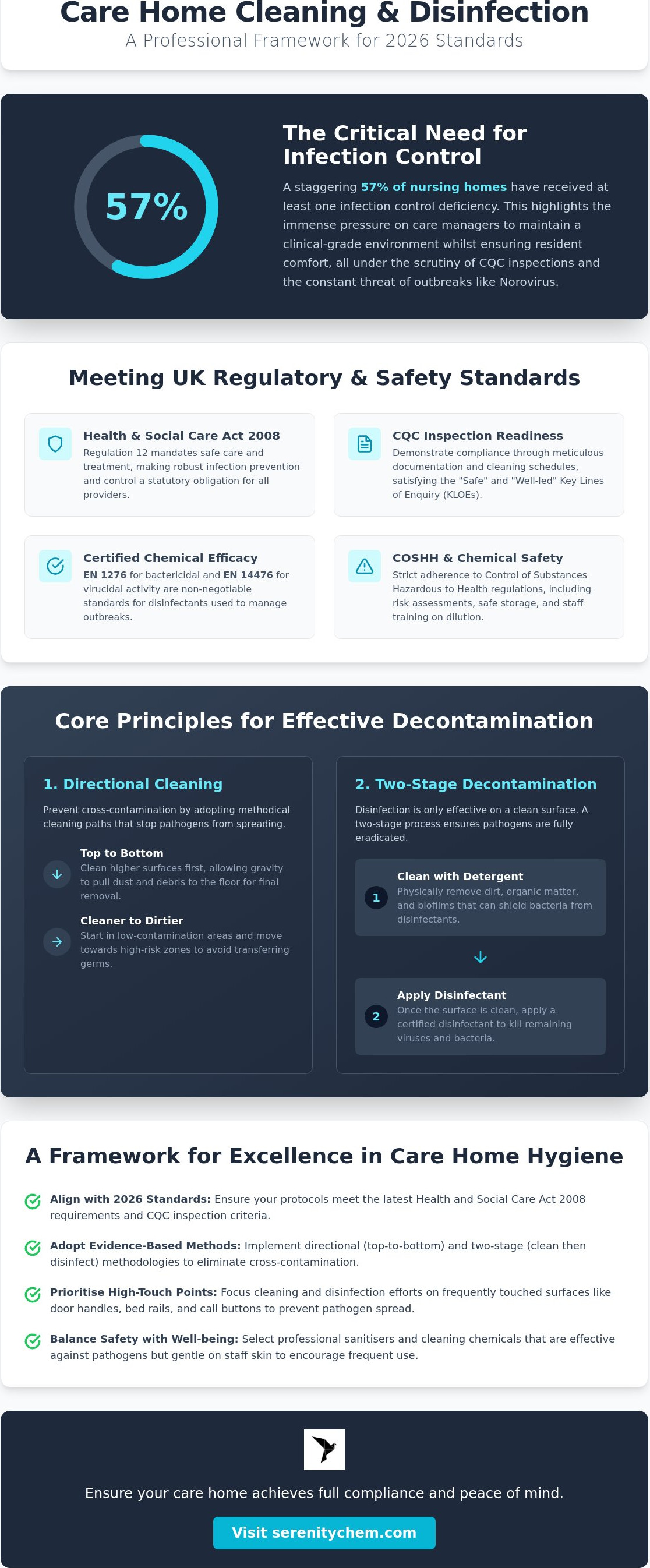
Did you know that 57% of nursing homes have received at least one infection control deficiency during recent inspections? This statistic highlights the immense pressure care managers face whilst trying to maintain a clinical-grade environment that still feels like home. It's constant work to balance complex staff training with the need for high-level safety, and it's understandable if the fear of a CQC inspection failure or a sudden Norovirus outbreak keeps you up at night. To support your team, we've compiled this professional framework for care home cleaning and disinfection guidelines to ensure you stay ahead of 2026 standards.
You likely believe that resident safety should be absolute, yet you shouldn't have to rely on harsh chemicals that cause skin irritation or respiratory discomfort for your staff. We promise to help you master the latest UK regulatory requirements and clinical best practices for maintaining a truly infection-free environment. This article provides a clear roadmap for achieving full compliance, reducing infection rates, and implementing cost-effective cleaning protocols that prioritise the well-being and peace of mind of everyone in your care.
Key Takeaways
- Align your facility with the latest Health and Social Care Act 2008 requirements and CQC inspection standards for 2026.
- Adopt evidence-based cleaning methodologies, such as directionality and top-to-bottom cleaning, to eliminate cross-contamination risks.
- Master the latest care home cleaning and disinfection guidelines to achieve full regulatory compliance and improve resident safety outcomes.
- Balance effective infection control with staff well-being by selecting sanitisers that preserve skin integrity during frequent use.
- Identify the essential professional cleaning chemicals needed to manage high-touch points and prevent the spread of enteric pathogens.
The Regulatory Framework for Care Home Hygiene in 2026
The legal foundation for hygiene in adult social care is built upon the Health and Social Care Act 2008. Specifically, Regulation 12 requires providers to provide safe care and treatment, which includes preventing and controlling the spread of infections. In 2026, adhering to established care home cleaning and disinfection guidelines is the first step toward demonstrating that your facility is meeting these statutory obligations. The Care Quality Commission (CQC) doesn't just look for clean surfaces; they look for a robust culture of safety supported by Infection prevention and control principles that are consistently applied by every member of staff.
For a cleaning programme to be considered effective, the chemistry used must meet rigorous European Standards. EN 1276 is the requirement for bactericidal activity, whilst EN 14476 confirms that a product is effective against viruses. These certifications are non-negotiable for managing outbreaks like Norovirus or seasonal influenza. An inspector will expect to see these standards clearly stated on your product data sheets and integrated into your daily protocols. Beyond the choice of chemicals, maintaining an inspection-ready audit trail is vital. This means every cleaning task, from high-touch point wiping to deep room disinfections, must be documented with precision.
CQC Inspection Readiness and IPC Standards
Documentation is your strongest evidence during a CQC visit. To satisfy Regulation 12, cleaning schedules should be granular, detailing what was cleaned, when, and by whom. The CQC focuses on two specific Key Lines of Enquiry (KLOEs): "Safe" and "Well-led". A "Safe" rating depends on your ability to prove that risks of cross-contamination are minimised. A "Well-led" rating reflects how management monitors these tasks. Integrating the National Standards of Healthcare Cleanliness into your care setting provides a structured framework that mirrors hospital-grade safety, ensuring your care home cleaning and disinfection guidelines are beyond reproach.
COSHH and Chemical Safety
Managing professional-grade chemicals requires strict adherence to the Control of Substances Hazardous to Health (COSHH) regulations. Every cleaning product in your cupboard needs a corresponding risk assessment that outlines potential hazards and necessary protective measures. Safe storage is equally critical; chemicals must be kept in secure, well-ventilated areas away from resident access. Training is the final piece of the puzzle. Staff must be competent in chemical dilution ratios and application methods to avoid wasting resources or, worse, creating safety hazards through improper mixing. Regular competency checks ensure that safety remains a practical reality rather than just a policy on paper.
Evidence-Based Cleaning Techniques and Principles
Effective hygiene in a residential setting requires a methodical approach that mirrors clinical safety without sacrificing the comfort of the residents' home. One of the most fundamental care home cleaning and disinfection guidelines is the "cleaner to dirtier" principle. By starting in the cleanest areas and moving toward those with higher contamination risks, staff prevent the accidental spread of pathogens across different zones. This logic extends to vertical cleaning; always work from the top of a room downwards. Gravity ensures that dust and debris fall to the floor, where they can be captured during the final mopping stage rather than resettling on surfaces already sanitised.
Establishing a two-stage process is vital for true decontamination. You can't effectively disinfect a surface that's still covered in organic matter or biofilms, as these layers protect bacteria from chemical action. The first stage involves using a detergent, such as Serenity Multi-Surface Cleaner, to physically remove grime. Only once the surface is visibly clean should the second stage—disinfection—begin. Whilst international state-level regulatory standards provide a useful baseline for safety, UK care homes must adapt these principles to their specific layout, ensuring that high-traffic communal areas receive more frequent attention than low-occupancy administrative spaces.
The 4-Step Disinfection Protocol
To ensure consistency across your team, implement a standardised four-step protocol for every room. Start with a visual site assessment to identify and remove any organic matter. Follow this with a thorough detergent clean to break down surface biofilms. The third step is the application of a certified product, like Serenity Antibacterial Surface Spray, ensuring the entire area is covered. Finally, verify that the disinfectant remains wet on the surface for the full required contact time. Skipping this final wait period is a common mistake that significantly reduces the efficacy of your care home cleaning and disinfection guidelines.
Colour-Coding Systems for Care Homes
A robust colour-coding system is the simplest way to prevent cross-contamination between high-risk and general areas. In the UK, the standard approach uses red equipment for bathrooms and toilets, whilst blue is reserved for general areas like bedrooms and lounges. This visual cue ensures a mop used in a wet room never touches the floor of a communal dining space. To maintain the integrity of this system, you must also manage the laundry cycle carefully. Microfibre cloths should be laundered at high temperatures and replaced regularly once they show signs of wear. If you need help discussing your specific requirements with our team, we can provide guidance on implementing these systems effectively.
Surface-Specific Guidelines: From High-Touch to Soft Furnishings
Pathogens don't treat all surfaces equally. Whilst a door handle is a transit point for bacteria, a carpet acts as a long-term reservoir for dust and microbes. Effective care home cleaning and disinfection guidelines must differentiate between these environments to ensure no area is neglected. High-touch surfaces like handrails, call bells, and light switches require frequent intervention because they're handled by dozens of people daily. Bathrooms also demand specific attention; enteric pathogens like Norovirus can linger on hard surfaces if the disinfection protocol isn't robust enough. Following CDC disinfection and sterilization guidelines helps establish a baseline for how often these critical areas should be addressed.
Communal areas present a dual challenge. Hard floors must be kept clean to prevent the spread of infection, yet they also need to be safe for residents with limited mobility. Slips and trips are a major risk in care settings, so choosing the right chemistry is vital. Soft furnishings, particularly carpets in lounges and bedrooms, are often overlooked in standard hygiene audits. They can trap skin cells and allergens, making deep cleaning essential for maintaining air quality and resident health. Addressing these diverse surfaces with a unified strategy ensures that your facility remains both a safe clinical environment and a comfortable place to live; to see how professional services maintain such high standards, you can discover Sani-Tech Victoria and their comprehensive approach to facility hygiene.
High-Touch Disinfection Protocols
In a busy facility, the frequency of cleaning should reflect the level of use. Under standard care home cleaning and disinfection guidelines, high-touch points should be sanitised at least twice daily. During an active outbreak, this frequency must increase to every few hours. Using a targeted solution like Serenity Antibacterial Surface Spray allows for rapid turnover without leaving sticky residues. This is particularly useful for resident mobility aids, such as walking frames and wheelchairs. These items are often made of sensitive materials that require a gentle yet effective touch to prevent damage over time.
Floor and Carpet Maintenance
Hard floors in communal zones benefit from a no-rinse strategy that maintains traction whilst removing biofilms. Partnering with a reliable commercial floor cleaner supplier ensures you have access to professional-grade solutions that dry quickly and safely. For soft surfaces, a regular vacuuming schedule isn't sufficient to eliminate deep-seated bacteria. Periodic deep cleaning with Serenity Carpet Shampoo helps neutralise odours and remove allergens from the pile. When managing spills of blood or bodily fluids on porous surfaces, it's vital to act quickly. Blotting the area and applying a specialised sanitiser prevents the fluid from soaking into the sub-floor, where it could become a permanent source of contamination.
Hand Hygiene and Staff Protection in Care Settings
Hand hygiene isn't just a personal habit; it's a clinical necessity that sits at the very heart of your infection control strategy. Whilst the previous sections of this framework focused on environmental surfaces, this section addresses the primary vector for cross-contamination: human hands. Effective care home cleaning and disinfection guidelines must recognise that staff hands are in constant contact with both residents and their immediate surroundings. If hand hygiene protocols fail, even the most rigorous surface cleaning becomes redundant as pathogens are quickly redistributed across the facility.
A significant gap in many standard hygiene guides is the failure to address staff skin health. Frequent use of harsh, alcohol-based sanitisers often leads to contact dermatitis. When staff members develop sore or cracked skin, they're less likely to comply with sanitisation protocols, and damaged skin can actually become a reservoir for bacterial colonisation. To safeguard against this, you can explore MRSA Culture – Nose/Groin kits to screen for carriage in high-risk environments. Balancing efficacy with skin integrity is a hallmark of a principled approach to care. By providing solutions that protect the skin's natural barrier, you ensure that your team can maintain high standards of safety without physical discomfort. Placing dispensers at the point of care, such as at the entrance to resident rooms and communal dining areas, further encourages compliance by making sanitisation a seamless part of the daily workflow.
The Benefits of Alcohol-Free Sanitisation
Choosing an alcohol free hand sanitiser UK professionals trust provides several operational advantages. These formulations are generally much gentler on sensitive skin, making them ideal for staff who must sanitise their hands dozens of times per shift. Beyond skin health, alcohol-free options reduce fire risks and eliminate the hazard of accidental ingestion, which is a vital consideration in dementia care units. Many modern non-alcohol sanitisers also offer residual efficacy, meaning they continue to provide a level of protection against microbes even after the solution has dried on the skin.
Staff Training and Compliance
Compliance is driven by clear expectations and consistent training. The World Health Organisation's "5 Moments for Hand Hygiene" should be adapted specifically for your residential setting, ensuring staff know exactly when to act. This includes before and after resident contact, as well as after touching any objects in a resident's room. Regular audits, coupled with constructive feedback, help reinforce these behaviours. Implementing a "bare below the elbows" policy is also essential, as it allows for more thorough washing of the hands and wrists. If you're looking to upgrade your facility's safety protocols, you can contact our specialists for a tailored consultation on the best products for your team.
Selecting Professional Cleaning Chemicals for 2026
The final pillar of a robust hygiene strategy is the procurement of the chemistry itself. Whilst having the right care home cleaning and disinfection guidelines in place is essential, those policies are only as effective as the products your staff use. Choosing a specialist cleaning products manufacturer UK care providers trust ensures that you receive consistent, high-quality formulations. Direct sourcing also provides a clear line of accountability, which is vital when you need to verify the ethical and environmental credentials of your supply chain. In 2026, care managers are increasingly looking for partners who prioritise both efficacy and responsibility.
When building your inventory, it's easy to focus on the initial purchase price, but this can be misleading. A more accurate metric is the cost-per-use. High-concentration professional products often prove more economical than cheaper, pre-diluted alternatives because they last longer and reduce plastic waste. Every facility should maintain a comprehensive professional cleaning chemicals list that covers all essential zones, from kitchens to resident bedrooms. This structured approach prevents over-ordering and ensures that your team always has the specific tools they need to maintain a safe environment.
Efficacy and Standard Verification
Verification is the most critical step in chemical selection. You must ensure that every disinfectant in your cupboard carries the correct certifications. EN 1276 confirms bactericidal efficacy, whilst EN 14476 is the standard for virucidal activity. Don't take these claims at face value; always request the technical data sheets from your supplier. Many modern care home cleaning and disinfection guidelines now favour products with residual antibacterial properties, which continue to protect surfaces between cleaning cycles. Sourcing versatile, multi-purpose solutions like Serenity Multi-Surface Cleaner can also simplify staff training by reducing the number of different chemicals they need to master.
Procurement and Supply Chain Reliability
Supply chain security has become a top priority for UK care homes. Working with a domestic manufacturer reduces the risk of delays and ensures that your facility remains fully stocked, even during periods of high demand. A specialist hygiene partner doesn't just sell you a bottle; they provide the technical support and documentation needed to satisfy CQC inspectors. This relationship is built on long-term trust rather than short-term transactions. If you're ready to align your facility with the highest safety standards, you can discover the Serenity range of professional care home cleaning chemicals to find a solution that fits your specific needs.
Prioritising Excellence in Infection Prevention
Maintaining a safe, compliant environment is a continuous commitment that requires both technical precision and the right chemistry. By aligning your facility with the latest regulatory standards and adopting evidence-based techniques, you don't just pass inspections; you create a sanctuary for your residents. Protecting your staff with gentle, alcohol-free hand hygiene solutions is equally vital for maintaining high compliance and long-term well-being. Consistently following these care home cleaning and disinfection guidelines ensures your home remains a leader in safety and care.
Serenity Chemicals has been trusted by UK care providers since 2020 to deliver high-performance solutions that meet the most rigorous standards. Our EN 14476 and EN 1276 certified formulations provide the clinical-grade protection you need without compromising the comfort of a residential setting. If you're ready to enhance your hygiene protocols with professional-grade chemistry, view our full range of UK-manufactured care home cleaning chemicals today. Together, we can build a future where safety and care go hand in hand.
Frequently Asked Questions
How often should high-touch surfaces be cleaned in a care home?
High-touch surfaces require cleaning at least twice daily during normal operations. This frequency must increase to every few hours during a suspected or confirmed outbreak. Focus on items like call bells, door handles, and handrails, as these are the primary transit points for bacteria and viruses amongst residents and staff.
What EN standards should care home disinfectants meet in 2026?
Professional disinfectants must carry EN 1276 and EN 14476 certifications to be considered fit for purpose. EN 1276 confirms the product's ability to kill 99.999% of bacteria, whilst EN 14476 verifies its efficacy against viruses. Always check the technical data sheets from your supplier to confirm these standards are met before procurement.
Is alcohol-free hand sanitiser effective against Norovirus?
Yes, specific alcohol-free hand sanitisers are highly effective against Norovirus and other non-enveloped viruses. Many alcohol-based products struggle to penetrate the protein shell of these pathogens, but advanced alcohol-free formulations provide the necessary broad-spectrum protection. They also help maintain skin integrity, which is vital for staff who sanitise their hands frequently throughout a shift.
Do care homes need to use different chemicals during an outbreak?
You don't typically need different chemicals if your current inventory already meets high-level EN standards. However, your care home cleaning and disinfection guidelines should specify increased application frequencies and potentially longer contact times during an outbreak. Using a multi-purpose sanitiser that is already certified against viruses ensures your team is always prepared for sudden infection surges.
How can I ensure our care home cleaning schedule is CQC-compliant?
Compliance is achieved through meticulous, granular documentation that satisfies the "Safe" and "Well-led" KLOEs. Your care home cleaning and disinfection guidelines must be supported by signed logs that show exactly what was cleaned, when, and by whom. This level of transparency proves to inspectors that your hygiene protocols are a lived reality rather than just a policy document.
Can the same microfibre cloth be used for multiple resident rooms?
No, you must change microfibre cloths between every resident room to eliminate the risk of cross-contamination. Using a single cloth across multiple rooms can spread pathogens from one environment to another, undermining your entire infection control strategy. A robust colour-coding system helps staff easily identify which equipment is designated for specific zones or tasks.
What is the best way to disinfect carpets in a residential care setting?
Deep cleaning with a specialised carpet shampoo is the most effective way to manage porous surfaces. Whilst hard floors are easier to sanitise, carpets trap allergens and microbes deep within their fibres. Periodic extraction cleaning with an odour-neutralising formula ensures that these soft furnishings don't become a long-term reservoir for bacteria or unpleasant smells.
Is it better to buy cleaning chemicals in bulk or ready-to-use formats?
Bulk procurement is usually the superior choice for professional care settings because it significantly lowers the cost-per-use. Whilst ready-to-use bottles offer initial convenience, they generate more plastic waste and are more expensive over time. Buying concentrates and training staff on correct dilution ratios provides a more sustainable and cost-effective solution for large-scale facilities.

Hand Sanitiser for Frequent Use: Professional UK Guide 2026
The very product you use to protect your health might be the primary cause of your skin's deterioration. While alcohol-based ...

Food Safe Antibacterial Spray UK: The Professional 2026 Hygiene Guide
Using the wrong disinfectant in a commercial kitchen isn't just a minor oversight; it's a direct threat to your Food Hygiene ...