

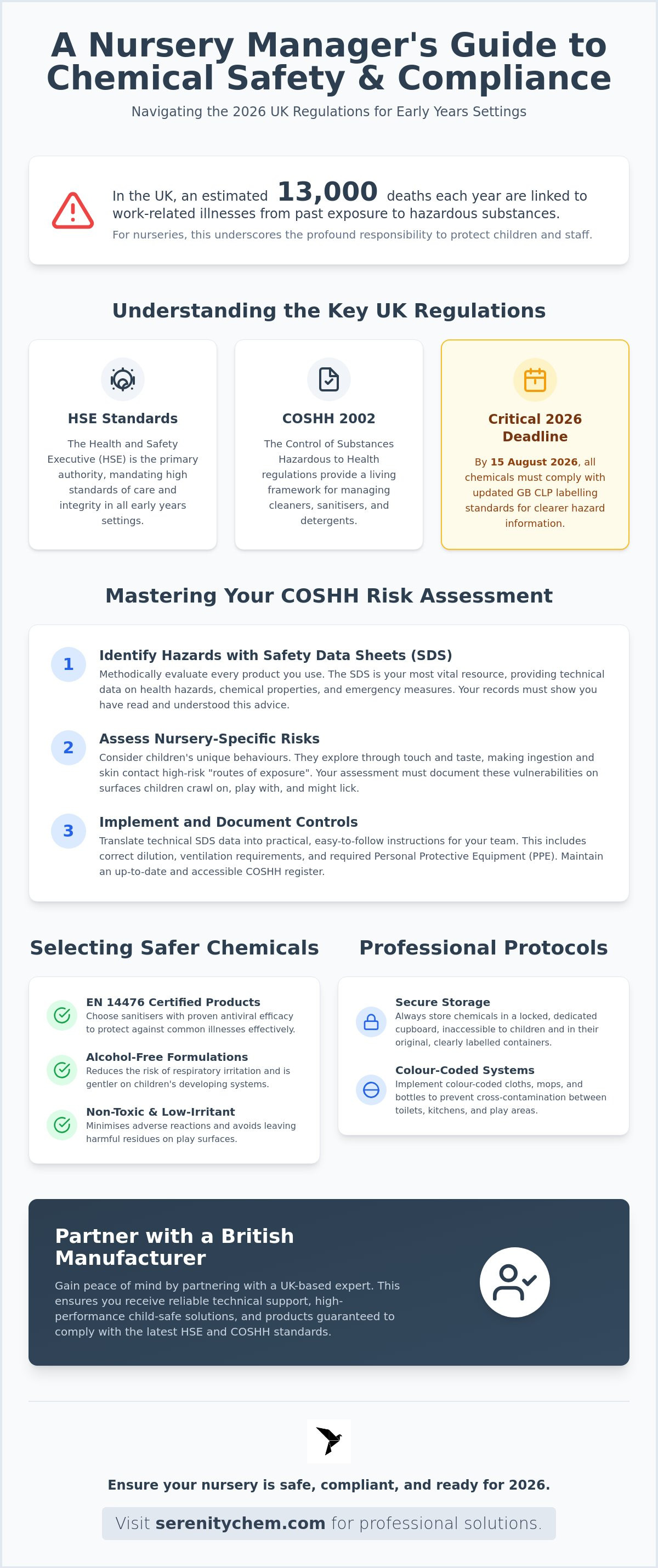
Did you know that approximately 13,000 people die each year in the UK from work-related illnesses caused by exposure to hazardous substances? For nursery managers, this figure represents a profound responsibility to protect the vulnerable children in your care whilst maintaining a sterile environment. You likely feel the pressure of upcoming Ofsted inspections and the constant anxiety that a standard cleaning product might cause an adverse respiratory reaction or be accidentally ingested.
We understand that keeping up with the nursery cleaning chemicals regulations UK can feel like a full-time job in itself. This professional guide simplifies the complexities of the 2026 legal updates, including the critical August 15 deadline for GB CLP labelling, to ensure your setting remains safe and compliant. You'll gain a clear roadmap for mastering COSHH assessments and transitioning to safer, more effective cleaning protocols. We'll explore the latest HSE standards and help you build a system that provides total peace of mind for both your staff and parents.
Key Takeaways
- Learn how to navigate the latest nursery cleaning chemicals regulations UK to ensure your setting remains fully compliant with 2026 HSE and COSHH standards.
- Master the essential steps for conducting a robust COSHH risk assessment and maintaining an up-to-date Safety Data Sheets (SDS) folder.
- Discover why choosing alcohol-free formulations and EN 14476 certified antiviral products is the most effective way to protect children's developing systems.
- Implement professional storage protocols and colour-coded cleaning systems to eliminate cross-contamination risks and maintain a secure environment.
- Understand the benefits of partnering directly with a British manufacturer for reliable technical support and high-performance, child-safe cleaning solutions.
Navigating UK Nursery Cleaning Chemical Regulations in 2026
Ensuring the safety of staff and children requires more than just a tidy room. In 2026, the nursery cleaning chemicals regulations UK have undergone significant updates to reflect modern health standards and tightened chemical classifications. The Health and Safety Executive (HSE) remains the primary authority overseeing these standards, ensuring that every early years setting operates with high levels of integrity and care. Compliance is no longer just about cleanliness; it's about the principled selection of substances that protect developing respiratory systems.
Central to this safety environment is the COSHH Regulations 2002. For a nursery, COSHH isn't merely a binder kept in an office. It's a living framework that dictates how you manage everyday substances like floor cleaners, sanitisers, and laundry detergents. Since many professional-grade products contain ingredients that can irritate sensitive skin or trigger asthma, they're legally classified as hazardous substances. The HSE expects managers to understand these risks thoroughly and implement controls that prioritise child safety above all else.
The regulatory environment became more stringent on 30 April 2026, with the introduction of the Chemicals (Health and Safety) (Amendment) Regulations 2026. A critical deadline is now approaching. By 15 August 2026, all cleaning chemicals used in your nursery must comply with updated GB CLP labelling standards. These changes ensure that hazard information is clearer and more readable, helping your team avoid dangerous mistakes during busy shifts. Transitioning to non-toxic and low-irritant formulations is the most reliable way to meet these evolving expectations whilst maintaining a clinical level of hygiene.
The Legal Framework: COSHH 2002 and Beyond
In a nursery, any substance that can cause harm if inhaled, ingested, or touched falls under COSHH. Recent updates have tightened the classification of substances identified as endocrine disruptors, which are being phased out of professional products. There's also a clear shift towards requiring higher antiviral efficacy, specifically the EN 14476 standard. Failing to maintain an accurate COSHH register or using outdated labels after the August 2026 deadline can lead to serious legal repercussions and safety failures.
Ofsted Expectations for Hygiene and Safety
Ofsted inspectors use the Early Years Foundation Stage (EYFS) statutory framework to evaluate your setting's health and safety protocols. They look for evidence of due diligence in your chemical selection process. You must demonstrate that you've considered the risks to children's health, opting for safer alternatives where possible. A high hygiene rating is often a direct result of well-documented cleaning schedules and the use of products that don't leave harmful residues amongst the play areas.
Conducting a COSHH Risk Assessment for Early Years Settings
A thorough risk assessment is the cornerstone of managing nursery cleaning chemicals regulations UK. It's a methodical process that moves beyond a simple tick-box exercise. You must evaluate every product under your roof, from the hand wash in the staff toilets to the heavy duty degreasers in the kitchen. The goal is to identify who might be harmed and how, then implement principled controls to prevent that harm from occurring. This systematic approach ensures your setting remains a sanctuary for both staff and children.
Safety Data Sheets (SDS) are your most vital resource during this phase. An SDS provides technical data on chemical properties, health hazards, and emergency measures. However, simply having these sheets in a folder isn't enough. You must translate that technical data into practical instructions for your team. For instance, if an SDS indicates a product is a respiratory sensitiser, your assessment must determine if using it in a poorly ventilated changing room poses an unacceptable risk to infants. Your records should show that you've read, understood, and acted upon the specific safety advice provided by the manufacturer.
When assessing risks for children, you must consider their unique behaviours. Young children explore their world through touch and taste. This means "routes of exposure" like ingestion and skin contact are much higher risks in a nursery than in an adult office. Surfaces aren't just for looking at; they're for crawling on and, occasionally, licking. Your documentation should clearly reflect these nursery-specific vulnerabilities to satisfy health and safety auditors and demonstrate your commitment to ethical care.
Identifying Hazards: Beyond the Warning Label
Many standard cleaners contain volatile organic compounds (VOCs), dyes, and synthetic fragrances that can trigger allergic reactions or asthma in developing lungs. Identifying these irritants is essential. It's also vital to distinguish between cleaning (removing dirt), sanitising (reducing bacteria to safe levels), and disinfecting (killing specific viruses). In a nursery, you often need the high efficacy of a disinfectant without the harsh chemical profile of industrial bleach. For this reason, fragrance-free and dye-free options are the gold standard for 2026.
Implementing Control Measures
Following the hierarchy of control is a legal requirement. Substitution is your most powerful tool; if you can replace a harsh chemical with a safer alternative, you must do so. Utilising high-quality professional cleaning chemicals designed for sensitive environments can significantly reduce your risk profile. You should also consult the HSE COSHH Essentials for Cleaning for specific guidance on manual surface disinfection and safe dilution ratios. Correct dilution prevents the buildup of irritating fumes in small rooms, ensuring the air remains fresh and safe for little lungs.
If you're unsure how to align your current inventory with these requirements, you can always reach out to our technical team for guidance on building a compliant chemical register that protects your setting.
Balancing Efficacy and Child Safety: Selecting the Right Chemicals
Selecting the correct cleaning agents is a decision that carries significant ethical weight. Whilst the primary goal is to eliminate pathogens, you must do so without introducing new risks to the children in your care. This responsibility is explicitly outlined in the Early Years Foundation Stage (EYFS) Statutory Framework, which requires providers to promote the good health of children and ensure their environment is safe. In 2026, meeting the nursery cleaning chemicals regulations UK means looking beyond basic cleanliness to find principled, high-performance formulations.
The benchmark for antiviral efficacy in modern nurseries is the EN 14476 standard. This certification proves that a product is effective against enveloped viruses, which is critical given that respiratory viruses like RSV and rhinovirus are frequently found on nursery toys. However, achieving this level of disinfection shouldn't involve harsh bleach-based products. Chlorine-based cleaners can release irritating fumes that linger in poorly ventilated play areas, potentially causing respiratory distress in infants. Instead, professional settings are moving towards pH-neutral, non-corrosive alternatives that offer residual protection, reducing the need for constant chemical reapplication throughout the day.
The Case for Alcohol-Free Hand Sanitisers
Traditional alcohol-based gels present two major risks in an early years environment: accidental ingestion and fire hazards. Toddlers frequently put their hands in their mouths, and even a small amount of high-percentage alcohol can be harmful. Switching to an alcohol-free hand sanitiser UK standard ensures you maintain 99.99% efficacy whilst eliminating these specific dangers. These water-based formulas are also much kinder to the skin. Since nursery staff must wash or sanitise their hands dozens of times a day, non-drying, moisturising formulas help prevent contact dermatitis and maintain staff wellbeing.
Surface Disinfection: Choosing Child-Safe Formulas
In weaning rooms and high-traffic play areas, you need a solution that is both powerful and food-safe. Using a specialised antibacterial surface spray UK professionals trust allows you to disinfect surfaces without the need for a secondary rinse. This is essential for busy nursery schedules where staff need to sanitise a table and have it ready for the next activity immediately. We recommend prioritising products that are:
- Fragrance-free and dye-free: To minimise the risk of allergic reactions.
- EN 14476 certified: To ensure a broad spectrum of antiviral protection.
- pH-neutral: To protect sensitive skin and prevent damage to nursery furniture.
By focusing on these criteria, you ensure that your hygiene protocols are as responsible as they are effective, providing total peace of mind for both your team and the parents you serve.
Best Practices for Safe Storage and Handling in Nurseries
Establishing a secure environment for cleaning agents is just as critical as the selection of the products themselves. Whilst previous sections focused on the legal framework and chemical efficacy, the physical management of these substances is where your safety protocols are truly tested. Following the nursery cleaning chemicals regulations UK requires a disciplined approach to storage that eliminates the possibility of unauthorised access. A child's curiosity is boundless; therefore, your defensive measures must be absolute and principled.
A centralised, lockable chemical store is a mandatory requirement for any early years setting. This space should be well-ventilated, cool, and entirely inaccessible to children. Beyond the physical lock, you must implement a colour-coded cleaning system to prevent cross-contamination. In the UK, the standard approach uses red for washrooms and toilets, yellow for clinical areas, blue for general low-risk zones, and green for kitchens. This visual system ensures that a cloth used in a nappy-changing area never finds its way to a snack table, maintaining the high hygiene standards expected by both parents and inspectors.
Organising Your Chemical Store
The "Lock and Key" rule is the foundation of nursery safety. Every cleaning agent, from floor cleaner to toilet sanitiser, must be returned to this secure location immediately after use. It's vital that you never decant chemicals into unlabelled containers or old food jars; this is a common cause of accidental ingestion. All products must retain their original manufacturer labels to ensure that hazard information and usage instructions remain visible. Additionally, your team should manage stock rotation using a "first-in, first-out" method, ensuring that no products exceed their expiry dates and lose their antiviral efficacy.
Staff Training and PPE
Compliance is a team effort. You must identify "Competent Persons" within your staff who are specifically trained in chemical handling and the nuances of your COSHH register. Training should cover the correct use of Personal Protective Equipment (PPE), such as gloves and aprons, which should be worn during heavy cleaning tasks. To maintain a calm environment, staff should be trained to use PPE matter-of-factly, ensuring it doesn't alarm the children. Every training session must be documented in a log, providing the clear evidence of due diligence that Ofsted and insurance providers require.
In the event of an emergency, such as a chemical spill or accidental skin contact, your team must have immediate access to your spill kit and first aid protocols. These procedures should be displayed clearly within the chemical store. If you need assistance in training your team or setting up a compliant storage system, you can contact our specialists for a professional consultation on nursery safety standards.
Professional Solutions: Partnering with a UK Chemical Manufacturer
Adhering to the nursery cleaning chemicals regulations UK requires more than just a thorough understanding of the law; it requires access to high-performance products that you can trust. Managing a nursery involves a constant balancing act between clinical hygiene and child safety. By partnering directly with a British manufacturer like Serenity Chemicals, you bridge the gap between regulatory theory and practical application. This relationship ensures that your cleaning protocols are supported by the "Principled Expert" philosophy, where every formulation is designed with ethical responsibility and technical precision.
One of the primary benefits of a direct partnership is the level of technical support available to your management team. When you buy from a manufacturer, you aren't just purchasing a bottle of cleaner; you're gaining access to full Safety Data Sheets (SDS) and expert guidance on chemical application. This transparency is essential for maintaining your COSHH register and providing the due diligence evidence required by Ofsted. Streamlining your procurement with a consistent range of products also reduces the risk of accidental chemical mixing, as your staff become familiar with a single, compliant system of solutions.
The Serenity Advantage for Early Years
Our range is specifically formulated to meet the rigorous demands of childcare settings. For high-traffic play zones, the Serenity Multi-Surface Cleaner provides a powerful yet responsible solution for daily maintenance. In environments where hand hygiene is paramount, the Serenity Alcohol-Free Hand Sanitiser offers 99.99% efficacy without the risks associated with traditional gels. Furthermore, our status as a trusted commercial floor cleaner supplier ensures that even your largest surface areas are treated with industrial-grade quality that remains safe for crawling toddlers. We prioritise:
- Consistency: Identical formulations in every batch for predictable results.
- Compliance: Labels that are always updated to the latest 2026 GB CLP standards.
- Support: Direct access to the chemists who understand your setting's unique needs.
Commitment to British Quality and Safety
Choosing a cleaning products manufacturer UK based ensures that your supply chain remains resilient and reliable. Local manufacturing allows for stricter quality control and a reduced carbon footprint, aligning with the ethical values of many modern nurseries. Buying direct also eliminates the "middleman" costs often found with generic distributors, allowing you to invest more into the safety of your environment. Our dedication to creating child-safe, effective, and responsible chemicals means you can focus on what matters most: the development and wellbeing of the children in your care. By choosing principled solutions, you ensure that your nursery cleaning chemicals regulations UK compliance is both effortless and absolute.
Future-Proofing Your Nursery Safety Standards
Maintaining a hygienic environment in an early years setting is a continuous commitment to safety and ethical responsibility. We've explored how mastering COSHH risk assessments and selecting principled, EN 14476 certified products can transform your compliance journey. By focusing on non-toxic formulations and implementing secure storage protocols, you protect both the children in your care and your nursery's professional reputation during inspections.
Staying ahead of the nursery cleaning chemicals regulations UK doesn't have to be a source of administrative anxiety. When you choose a partner dedicated to British quality, you gain the peace of mind that comes with 100% compliant, UK-manufactured solutions. We provide full SDS documentation for every product, including our specialist alcohol-free and non-toxic formulations, ensuring your setting meets every HSE standard with confidence. Explore our range of child-safe, professional cleaning chemicals to discover how we can support your nursery's hygiene goals today.
Frequently Asked Questions
What are the main COSHH requirements for UK nurseries?
COSHH requires nursery managers to identify all hazardous substances and conduct written risk assessments if they employ five or more people. You must follow a hierarchy of control, prioritising the elimination or substitution of harsh chemicals with safer alternatives. Providing staff with clear instructions, appropriate protective equipment, and maintaining a formal chemical register are also essential legal necessities for every setting.
Do I need a separate risk assessment for every cleaning product?
You don't always need a separate document for every individual bottle if the products pose similar risks and are used in the same way. For example, you can group various surface sanitisers into a single assessment for general surface cleaning tasks. However, high-risk items like heavy duty degreasers or toilet cleaners usually require their own specific evaluations to account for their unique handling requirements.
Is it legal to use bleach in a nursery setting?
Using bleach is legal, but it's rarely recommended in modern early years settings due to the significant respiratory risks it poses to young children. Many nurseries now opt for safer, pH-neutral disinfectants that provide high efficacy without corrosive fumes. If you do use bleach, your COSHH assessment must justify why a safer alternative couldn't be used and detail strict ventilation and storage protocols.
How often should I update my nursery COSHH register?
You should review your COSHH register at least annually or whenever you introduce a new product to your inventory. Significant changes in nursery cleaning chemicals regulations UK, such as the 2026 CLP labelling updates, also trigger a mandatory review. Keeping these records current ensures you remain compliant with HSE standards and provides a clear, principled audit trail for Ofsted inspectors.
What is the best type of hand sanitiser for use around toddlers?
Alcohol-free hand sanitisers are the most responsible choice for environments with toddlers and young children. They eliminate the risk of accidental alcohol poisoning through ingestion and are much gentler on sensitive skin. These water-based formulas provide the necessary antiviral protection whilst remaining non-flammable and safe for frequent use by staff and children who explore their world through touch.
Does Ofsted require staff to have formal COSHH training?
Ofsted doesn't mandate a specific certificate, but they do require evidence that all staff are competent and have received adequate training on chemical safety. Your team must understand how to read labels, follow dilution ratios, and respond to emergencies like spills. Maintaining a signed training log is the most effective way to demonstrate this commitment to safety during a professional inspection.
Where can I find Safety Data Sheets for my cleaning chemicals?
Your chemical supplier or manufacturer is legally required to provide a Safety Data Sheet (SDS) for every professional product they sell. Most reputable British manufacturers provide these as digital downloads on their websites for easy access. You must ensure you have the most recent version, especially following the regulatory changes implemented in April 2026, to remain fully compliant.
What antiviral standards should I look for in 2026?
You should prioritise products that meet the EN 14476 standard, which is the recognised benchmark for antiviral efficacy in the UK. This certification ensures the product is effective against a broad range of viruses commonly found in childcare settings. Choosing certified products helps you meet nursery cleaning chemicals regulations UK whilst maintaining a safe, clinical environment that protects children's developing systems.

Hand Sanitiser for Frequent Use: Professional UK Guide 2026
The very product you use to protect your health might be the primary cause of your skin's deterioration. While alcohol-based ...

Food Safe Antibacterial Spray UK: The Professional 2026 Hygiene Guide
Using the wrong disinfectant in a commercial kitchen isn't just a minor oversight; it's a direct threat to your Food Hygiene ...