

Would you feel comfortable displaying a three-star cleanliness rating at your surgery's main entrance tomorrow morning? With the National Standards of Healthcare Cleanliness 2025 now requiring a public-facing star rating, your practice's hygiene is no longer just a matter for the inspectors; it's a visible promise to every patient who walks through your door. Meeting the latest CQC cleaning standards for GP surgeries involves more than just a tidy waiting room. It requires a rigorous adherence to CQC Regulation 15 and the specific efficacy requirements of BS EN 1276 and BS EN 14476.
We recognise that balancing these complex requirements whilst protecting your staff from the skin irritation caused by frequent hand hygiene is a difficult task. This guide provides the clarity you need to master the 2025 update and ensure your facility remains compliant, safe, and inspection-ready. You will discover a practical framework for cleaning audits, a breakdown of Regulation 15, and expert advice on choosing chemicals that protect both your clinical surfaces and your team.
Key Takeaways
- Understand the critical transition to the 2025 National Standards and how Regulation 15 establishes the legal framework for safe, suitable healthcare premises.
- Learn how to effectively manage infection prevention in high-risk treatment rooms and meet specific CQC expectations for maintaining soft furnishings like carpets and curtains.
- Identify why broad-spectrum disinfectants meeting BS EN 14476 are essential for virucidal efficacy in a clinical setting, moving beyond basic antibacterial claims.
- Implement a structured approach to CQC cleaning standards for GP surgeries by utilising the national colour-coding scheme and establishing rigorous, risk-based audit protocols.
- Discover how to select professional hygiene solutions that combine high-performance efficacy with the safety and integrity required for modern healthcare environments.
The Regulatory Landscape: CQC Regulation 15 and the 2025 National Standards
Compliance isn't a suggestion; it's a legal obligation under the Health and Social Care Act 2008. Regulation 15 mandates that all premises and equipment used by service providers must be clean, secure, and properly maintained. On 16 May 2025, the CQC published updated guidance to ensure these regulations reflect the most recent clinical risks. For practice managers, meeting CQC cleaning standards for GP surgeries means moving beyond a simple visual check. It involves creating a verifiable environment where safety is woven into daily operations.
The release of the National Standards of Healthcare Cleanliness 2025 on 5 February 2025 marked a significant shift in expectations. These standards replaced the 2021 version, and whilst the core requirements for primary care remain stable, the update introduced specific protocols for ambulance facilities. This is particularly relevant for GP-led urgent care centres that interface with patient transport or shared clinical equipment. The transition demands a move from reactive cleaning to a structured, proactive programme.
Legal accountability for these standards rests with the Registered Manager. They must prove that hygiene isn't just happening, but is being actively managed and documented. For those looking to ensure wider statutory compliance across their practice, including specialist accessibility and care assessments, click here. The CQC often references its "GP Mythbusters" series to clarify these expectations. Mythbuster 5, for instance, provides a clear lens through which inspectors view IPC compliance. It's not enough to simply hire a cleaning contractor. The Registered Manager must ensure that every contractor's work aligns perfectly with clinical safety protocols and that an audit trail exists to prove it.
The Health and Social Care Act 2008 Code of Practice
The IPC Code of Practice outlines 10 specific criteria that every GP surgery must meet. These criteria form the bedrock of Infection Prevention and Control (IPC) Requirements, covering everything from hand hygiene to the management of clinical waste. Staff training is a vital component here. Cleaning operatives in a GP setting are specialist cleaners, not general janitors. They need to understand cross-contamination risks and the proper use of PPE. Your IPC policy shouldn't sit in a drawer; it needs to be a living document, updated annually and accessible to every team member.
Key Changes in the 2025 National Standards for GPs
One of the most visible changes in the 2025 standards is the requirement for all healthcare providers, including GP surgeries, to display a public-facing star rating for cleanliness at their main entrance. Much like food hygiene ratings, this system is designed to provide transparency and peace of mind for patients. The 2025 update also demands a more rigorous, evidence-based approach to cleaning methodologies. Inspectors now look for documented proof that CQC cleaning standards for GP surgeries are being met through specific chemical contact times and the correct use of colour-coded equipment. For surgeries providing urgent care, the inclusion of ambulance-specific standards provides new, necessary guidelines for managing patient transition areas and shared equipment.
Essential Infection Prevention and Control (IPC) Requirements for GP Premises
High-risk zones such as minor surgery suites and treatment rooms demand the highest level of scrutiny during any inspection. Maintaining CQC cleaning standards for GP surgeries in these areas requires a clear division of labour between clinical staff and cleaning operatives. Whilst the cleaning team manages the floors and general surfaces, the responsibility for decontaminating clinical equipment often rests with the nursing or medical team. Inspectors look for evidence that practices are following CQC Regulation 15, which specifies that all clinical environments must be fit for purpose and properly maintained to prevent the spread of infection.
Effective waste management is another pillar of IPC that requires daily vigilance. You must ensure that clinical waste, general waste, and sharps are segregated correctly at the point of generation. This isn't just about safety; it's about compliance with the national colour-coding system. Hand hygiene protocols also extend beyond the mere presence of a sink. Your surgery must provide alcohol-free hand sanitisers or soap that is gentle on the skin to encourage high-frequency use amongst staff who may be prone to dermatitis. If you need assistance in identifying the right products for your high-risk zones, our team can provide tailored guidance on compliant hygiene solutions.
Clinical Equipment and Surface Decontamination
Surface decontamination must be performed with products that are specifically validated for clinical use. A "fit for purpose" hard surface sanitiser should be used on all high-touch points, including examination couches and trolley tops. When managing blood or body fluid spillages, your team must have immediate access to a spillage kit and follow a documented protocol that includes the use of a high-level disinfectant. This ensures that CQC cleaning standards for GP surgeries are upheld even in the event of an incident, protecting both patients and staff from potential pathogens.
Managing Curtains, Blinds, and Carpets
Soft furnishings present a unique challenge for infection control. CQC guidance generally advises against the use of carpets in clinical areas because they cannot be effectively decontaminated after a spillage. If carpets are present in non-clinical zones, like waiting rooms or administrative offices, they require regular deep cleaning using a professional carpet shampoo to prevent the build-up of allergens and bacteria. Window blinds are another common IPC red flag; dust accumulation on slats can harbour pathogens and is often noted by inspectors. For privacy curtains, you must decide between fabric and disposable options. Fabric curtains should be laundered at 60 degrees Celsius every six months, whereas disposable curtains must be dated upon installation and replaced every six months, or sooner if they become visibly soiled.
Selecting Compliant Cleaning Chemicals: EN Standards and Efficacy
Choosing the correct chemical tools is where practice policy meets daily reality. The CQC expects providers to use products that are validated for their specific clinical environment. Whilst many retail products claim to be "antibacterial," healthcare settings require broad-spectrum disinfectants that align with the National Standards of Healthcare Cleanliness. The gold standard for virucidal efficacy is BS EN 14476. To meet this standard, a disinfectant must demonstrate a 99.99% reduction in viral activity. In a GP surgery, where patients may present with unknown viral loads, this level of protection is essential for maintaining safety.
Managing these chemicals also requires meticulous documentation to satisfy CQC cleaning standards for GP surgeries. Every product in your cupboard must have a corresponding Safety Data Sheet (SDS) as part of your COSHH compliance. These documents shouldn't just be filed away; they must be accessible to staff to ensure they understand the correct handling and dilution protocols. Opting for UK-manufactured chemicals provides an extra layer of reliability. It simplifies your supply chain and ensures that formulations are specifically designed to meet British safety and efficacy regulations.
EN 1276 and EN 13697: Bactericidal Standards
For general surface disinfection in waiting areas and reception desks, look for products certified to BS EN 1276. This standard requires a product to achieve a 99.999% reduction in bacteria within a five-minute contact time. It's a common pitfall during audits to "spray and wipe" immediately. If the chemical requires sixty seconds to work, wiping it off in ten seconds renders the process ineffective. Understanding these technical nuances is vital for a successful inspection. You can find more detail on selecting the right tools in our professional guide to antibacterial surface spray UK.
Hand Sanitiser Efficacy and Skin Integrity
Hand hygiene is the most effective way to prevent cross-contamination, yet frequent use of harsh chemicals often leads to contact dermatitis amongst clinical staff. This is why many practices are now integrating alcohol free hand sanitiser UK formulations into their protocols. These products provide the necessary pathogen kill rates without stripping the skin's natural oils. Foaming sanitisers are often preferred over traditional gels because they provide better coverage across the hands and fingers. They stay on the skin longer, ensuring the required contact time is met whilst being significantly more comfortable for the user during a busy shift.
Operational Excellence: Cleaning Schedules, Colour Coding, and Audit Protocols
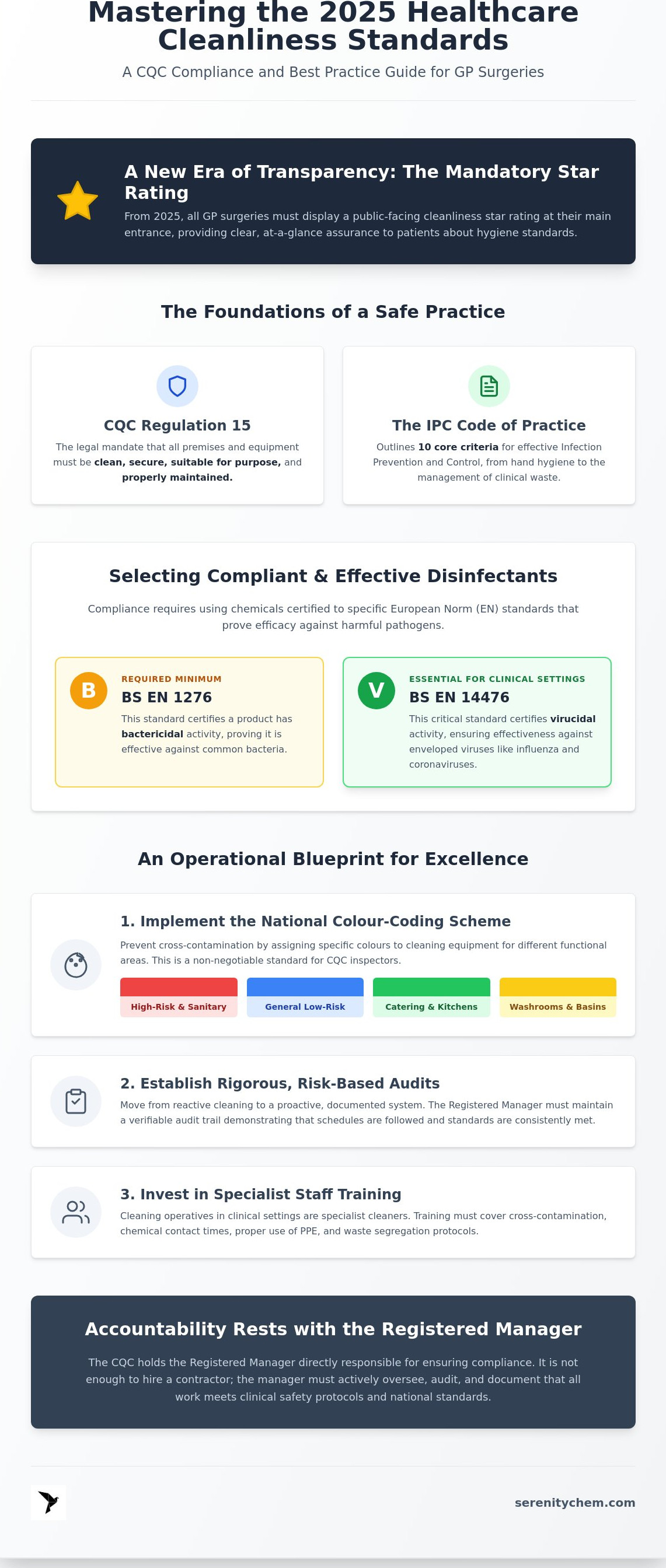
Operational excellence is the bridge between a written policy and a safe clinical environment. To maintain CQC cleaning standards for GP surgeries, you must move beyond generic cleaning and adopt a structured, risk-based approach. The National Colour Coding Scheme is a non-negotiable component of this framework. By assigning specific colours to equipment, you create a visual system that effectively eliminates the risk of cross-contamination. In a healthcare setting, the standard colours are:
- Red: Bathrooms, toilets, and basins.
- Blue: General areas, including reception desks, waiting rooms, and administrative offices.
- Green: Kitchens and catering environments.
- Yellow: Clinical areas, treatment rooms, and minor surgery suites.
Documentation is your primary defence during an inspection. Displaying a "Commitment to Cleanliness" Charter in your waiting room is a requirement of the National Standards. This charter isn't just a poster; it's a public promise that your surgery adheres to rigorous hygiene protocols. If you're looking to upgrade your current inventory to meet these demands, you can contact our hygiene experts for a consultation on implementing these systems effectively.
Setting Up Your Cleaning Schedule
A robust cleaning schedule must differentiate between daily maintenance and periodic deep cleaning. High-frequency touchpoints, such as door handles, keyboards, and chair armrests, require disinfection multiple times a day. These surfaces are the most likely vectors for pathogen transmission. Your janitorial staff should be fully trained on the ultimate professional cleaning chemicals list to ensure they're using the correct formulations for each task. A risk-based schedule ensures that resources are focused where they're needed most, such as treatment rooms after clinical procedures.
The Audit Trail: Proving Compliance to CQC
The CQC doesn't just want to see a clean surgery; they want to see the proof. Cleaning logs act as your audit trail, providing a daily record of completed tasks signed by the operative. Whilst visual audits are the most common form of assessment, many practices now use Adenosine Triphosphate (ATP) testing for objective data. ATP testing detects organic matter that isn't visible to the naked eye, providing a higher level of assurance. When an audit fails to meet the required standard, you must document the corrective actions taken. This demonstrates a proactive approach to CQC cleaning standards for GP surgeries and shows that your practice values continuous improvement.
Maintaining Excellence with Serenity Chemicals: Professional Hygiene Solutions
Serenity Chemicals understands that healthcare providers require more than just cleaning agents; they need a partnership built on ethical responsibility and technical precision. As a dedicated provider of UK based chemical supply, we ensure that every formulation meets the stringent demands of 2026 clinical environments. Our commitment to high-performance, EN-compliant solutions allows practice managers to meet CQC cleaning standards for GP surgeries without compromising on safety or ethical values. We believe that professional hygiene should be both effective and responsible, which is why our entire range consists of cruelty-free solutions designed for the modern medical practice.
Choosing the right supplier is about more than just procurement; it's about trust and peace of mind. Our formulations are developed with a focus on integrity, ensuring that you have the documentation and efficacy data required to satisfy any inspector. By manufacturing locally in the UK, we offer a reliable supply chain that avoids the delays often associated with international shipping. This steady availability is crucial for maintaining the rigorous daily schedules that CQC cleaning standards for GP surgeries demand. Our goal is to provide a seamless experience where compliance becomes a natural outcome of using the right tools.
Serenity Alcohol-Free Hand Sanitiser for Clinical Staff
High-frequency hand hygiene is a cornerstone of infection prevention, yet it often comes at a cost to staff wellbeing. Traditional alcohol-based gels can lead to painful contact dermatitis, causing significant discomfort and potentially reducing compliance amongst the team. Serenity Alcohol Free Hand Sanitiser offers a superior alternative for clinical staff. This fragrance-free and non-flammable formula is designed specifically for sensitive clinical environments. It provides proven efficacy against 99.99% of common healthcare-associated pathogens whilst remaining gentle on the skin. By protecting the skin's natural barrier, you ensure that your team can maintain the highest hygiene standards throughout a busy shift without the risk of irritation.
Comprehensive Surface and Floor Care
Achieving operational excellence in treatment rooms requires tools that work as hard as your clinical team. Serenity Antibacterial Surface Spray provides a rapid, effective solution for decontaminating high-touch surfaces between patient appointments. It's simple to use and fully compliant with the efficacy standards discussed earlier in this guide. For non-clinical areas, maintaining flooring to a high standard is equally important for a positive CQC assessment. Utilising commercial floor care solutions like Serenity Floor Cleaner ensures that waiting rooms and corridors remain pristine and slip-resistant. The Serenity promise is simple: we provide the effective, compliant, and ethical products you need to keep your surgery safe and your team protected.
Future-Proofing Your Practice for 2026 and Beyond
Adopting the 2025 National Standards is a significant step toward operational excellence. By focusing on the rigorous requirements of CQC Regulation 15 and the new star-rating system, you're ensuring that your surgery is both safe and transparent for every patient. Meeting CQC cleaning standards for GP surgeries doesn't have to be an administrative burden. It's an opportunity to refine your processes using evidence-based methodologies and high-performance chemical tools that provide peace of mind for staff and patients alike.
Our team provides the UK-manufactured, EN 14476 compliant solutions you need to maintain a sterile environment with confidence. We specialise in alcohol-free formulations that prioritise staff skin health without sacrificing virucidal power. If you're looking for a dependable partner to support your infection control journey, view our range of CQC-compliant cleaning chemicals and get in touch today. You've worked hard to build a trusted practice; we're here to help you protect it.
Frequently Asked Questions
How often should curtains be changed in a GP surgery according to CQC?
Curtains must be laundered or replaced every six months as a minimum standard. If they become visibly soiled or contaminated with body fluids, you should change them immediately. Using disposable curtains with clear installation dates helps your team track these intervals and provides easy evidence for CQC inspections.
Is it mandatory to have carpets in a GP practice waiting room?
There's no mandate to have carpets; in fact, hard flooring is often preferred because it's easier to decontaminate. If you choose to keep carpets in non-clinical zones like waiting rooms, you must document a regular deep-cleaning programme. This ensures your practice remains compliant with the broader CQC cleaning standards for GP surgeries.
What is the specific colour coding for cleaning a GP treatment room?
Yellow is the designated colour for all clinical areas, including treatment rooms and minor surgery suites. Following the national colour-coding scheme is essential to stop the spread of pathogens between different zones. Red is used for high-risk sanitary areas, whilst blue is reserved for general office and reception spaces.
Does the CQC require GP surgeries to display a cleanliness star rating?
Yes, displaying a star rating is now a mandatory requirement under the 2025 National Standards. This rating must be positioned in a prominent, public-facing area such as the main entrance. It provides patients with immediate transparency regarding the hygiene levels and safety protocols within your facility.
What EN standards should I look for in a medical-grade surface disinfectant?
You should prioritise products that meet BS EN 1276 for bacteria and BS EN 14476 for viruses. These certifications prove the chemical has been tested under controlled conditions and achieved the necessary pathogen reduction. Checking the specific contact time required to reach these standards is also vital for your cleaning protocols.
Can we use alcohol-free hand sanitiser in a clinical setting?
You can certainly use alcohol-free hand sanitiser, and it's often a better choice for maintaining staff skin health. These formulations are non-flammable and fragrance-free, making them ideal for busy clinical environments. They provide a reliable kill rate whilst being much kinder to the hands of your medical team during frequent use.
Who is responsible for infection control in a GP surgery?
The Registered Manager carries the ultimate legal accountability for IPC compliance under Regulation 15. However, most surgeries designate a senior staff member as the Infection Prevention and Control Lead. This person oversees the daily application of policies, manages staff training, and coordinates the essential audit cycles.
How long should we keep cleaning and audit records for a CQC inspection?
It's best practice to retain your cleaning logs and audit results for a minimum of three years. This long-term record demonstrates a consistent culture of cleanliness to CQC inspectors. It allows you to track improvements and prove that any previous audit failures were addressed with effective corrective actions.

Hand Sanitiser for Frequent Use: Professional UK Guide 2026
The very product you use to protect your health might be the primary cause of your skin's deterioration. While alcohol-based ...

Food Safe Antibacterial Spray UK: The Professional 2026 Hygiene Guide
Using the wrong disinfectant in a commercial kitchen isn't just a minor oversight; it's a direct threat to your Food Hygiene ...