

Could the very chemical you trust to clean your production line be the silent catalyst for a failed safety audit or, worse, the corrosion of your most expensive stainless steel assets? It's a frustrating paradox that many UK maintenance managers face. You need a powerful food grade machinery degreaser to strip stubborn grease, yet you cannot risk residual odours tainting your products or harsh solvents damaging sensitive components. Navigating the mountain of COSHH and HACCP documentation, whilst keeping up with the August 2026 GB CLP hazard standards, often feels like a full-time job in itself.
We understand that your priority is a clean, audit-ready facility that operates without unnecessary downtime. This guide will help you master the complexities of food-safe chemical selection, ensuring your machinery lasts longer and your facility remains in total regulatory compliance. We will examine how to choose formulations that protect your equipment, simplify your mandatory digital waste tracking requirements, and keep your production line running efficiently through 2026 and beyond.
Key Takeaways
- Understand the vital distinction between standard industrial cleaners and a certified food grade machinery degreaser to prevent cross-contamination and ensure total regulatory compliance.
- Learn how to navigate complex NSF categories and HACCP documentation to maintain a transparent, audit-ready chemical management system within your facility.
- Identify the specific solvency and material compatibility requirements needed to protect sensitive stainless steel and aluminium components from pitting or corrosion.
- Master the "T.A.C.T" cleaning principle to optimise your application methods, reducing equipment downtime whilst improving hygiene standards.
- Discover the operational advantages of sourcing high-performance degreasing solutions directly from a specialist UK manufacturer to ensure supply chain integrity.
The Critical Role of Food Grade Degreasers in Machinery Maintenance
A food grade machinery degreaser is a specialised chemical solution designed specifically for use in environments where food is processed, packaged, or handled. Unlike standard industrial cleaners, these formulations are engineered to be safe for use near food contact surfaces. Their primary purpose is to emulsify fats, oils, and greases without leaving behind toxic residues or strong chemical odours that could compromise the integrity of the food product. In a professional UK facility, this chemical isn't just a cleaning agent; it's a fundamental component of your food safety management system.
Using a standard industrial degreaser in a food plant is a significant liability. These products often contain volatile organic compounds (VOCs) or aromatic hydrocarbons that can easily migrate into food products. This risk of cross-contamination isn't just a regulatory concern. It's a direct threat to consumer safety and your brand's reputation. Beyond safety, the right degreaser directly impacts machinery longevity. Without effective removal, grease can become carbonised under high temperatures, leading to mechanical friction, overheating, and premature part failure.
Grease vs. Food Safety: The Balancing Act
Traditional solvents are often strictly prohibited in food production zones due to their toxicity and persistence. To maintain safety, manufacturers must adhere to strict food-grade lubricant standards and chemical guidelines. Modern formulations rely on advanced surfactants that lower the surface tension between the soil and the machine part. This allows the cleaner to penetrate grease layers effectively whilst remaining within the "incidental food contact" threshold. This ensures that any minute, unintended contact does not pose a health risk to the end consumer.
Bio-films and Carbonised Build-up
Food processing facilities deal with a complex array of soils, ranging from heavy animal fats and proteins to synthetic lubricants used in high-speed conveyors. If these residues aren't completely removed, they provide a perfect anchor for bio-films. These are thin, resilient layers of microorganisms that adhere to surfaces, often hidden amongst complex machine parts or within microscopic pits in stainless steel. Grease acts as a protective shield for these bacteria, rendering standard disinfection efforts ineffective.
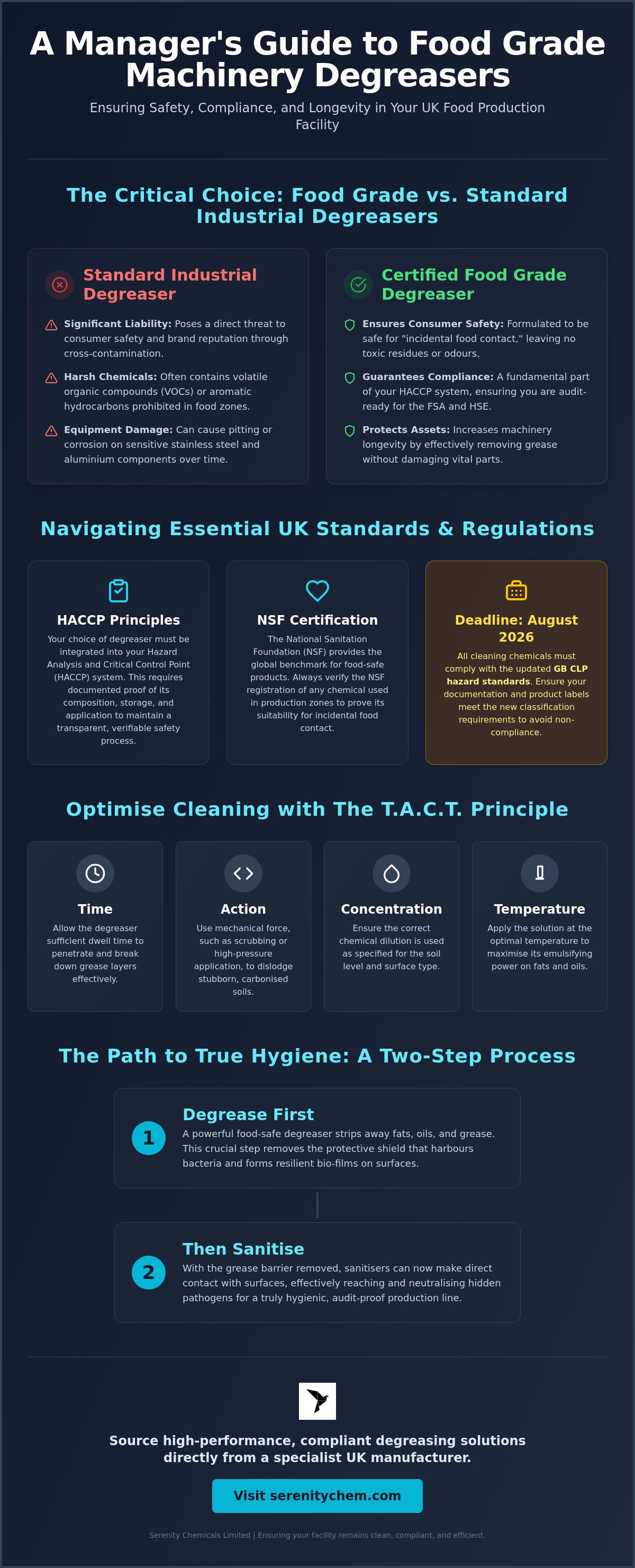
This is why a thorough degreasing stage is a mandatory prerequisite for the effective application of a food safe sanitiser for commercial kitchens. By stripping away the organic matter first, you ensure that subsequent sanitising steps can actually reach and neutralise pathogens. This two-step process keeps your production line both mechanically sound and hygienically safe, satisfying both maintenance engineers and health inspectors.
Essential Standards: HACCP and NSF Compliance for Food-Safe Degreasers
Selecting a food grade machinery degreaser involves much more than simply checking for a "non-toxic" label. For UK operators, compliance is a structured process that aligns with Hazard Analysis and Critical Control Point (HACCP) principles. These standards ensure that every chemical introduced into the production environment is accounted for; this includes its chemical composition, storage requirements, and specific application areas. It's about creating a transparent system where safety is verifiable at every stage.
In the UK, the Health and Safety Executive (HSE) and the Food Standards Agency (FSA) set the bar for operational safety. Following FSA guidance on effective cleaning is essential for any business aiming to pass a rigorous audit. By August 15, 2026, all cleaning chemicals must also comply with the updated GB CLP hazard standards. This means your documentation must be current and your labels must meet the new classification requirements to avoid legal non-compliance. Keeping your records digital and accessible is no longer just a preference; it's becoming a regulatory necessity.
Decoding NSF Ratings for Machinery
The National Sanitation Foundation (NSF) provides the global benchmark for food-safe chemicals. However, not all NSF-rated products are interchangeable. A1 ratings denote general cleaners suitable for all surfaces in and around food processing areas, provided they're rinsed off. In contrast, K1 ratings are reserved for solvent cleaners intended for use in non-processing areas, such as mechanical rooms. Using a K1 rated product on a conveyor belt that has direct contact with food is a common error. This mistake often leads to immediate audit failure. Always verify the specific category code on the product label before application.
UK Regulatory Compliance and Documentation
Managing chemical safety under COSHH (Control of Substances Hazardous to Health) requires a meticulous approach to record-keeping. Every degreaser on your site must have an up-to-date Safety Data Sheet (SDS). This document provides the essential data needed to conduct a thorough risk assessment for your staff. You should integrate these degreasing protocols directly into your Standard Operating Procedures (SOPs). This often includes a colour-coded cleaning system to ensure that machinery degreasers aren't accidentally used in areas where they might cause cross-contamination.
Choosing a UK-based manufacturer provides a level of supply chain transparency that is often missing with imported products. It allows for faster response times to legislative updates, ensuring your chemical procurement remains ethically and legally sound. If you're unsure how to align your current inventory with the 2026 regulatory changes, you might want to speak with a technical specialist for a compliance review. This proactive approach protects your staff and your production integrity.
Key Selection Criteria: How to Evaluate an Industrial Degreaser for Food Plants
Selecting a high-performance food grade machinery degreaser requires a technical evaluation that goes beyond simple cleaning power. Whilst industrial-strength solvency is necessary to emulsify heavy animal fats and carbonised oils, it must be achieved without leaving toxic residues or persistent chemical odours. In a food production environment, "fragrance-free" is the gold standard. Residual scents, even those perceived as "clean," can easily migrate into food products, leading to expensive batch rejections and consumer complaints. A truly effective solution should be nearly odourless and exhibit exceptional rinseability, ensuring a residue-free surface after every washdown cycle.
The chemical foundation of these products often relies on substances approved for food-contact surfaces. Whilst UK operators focus on domestic standards, global benchmarks like 21 CFR 178.1010 provide a clear list of approved components that form the basis of many safe formulations. When you evaluate a new product, look for these specific criteria:
- Emulsification Speed: How quickly the chemical breaks the bond between the grease and the machine surface.
- Rinse Profile: Whether the product leaves a film or rinses away cleanly with standard water pressure.
- Vapour Pressure: Lower vapour pressure reduces the risk of chemical inhalation for your maintenance team.
Material Compatibility and Corrosion
Aggressive high-pH degreasers are often highly effective at stripping grease, yet they can be devastating to "soft" metals like aluminium or certain alloys found in older machinery. Pitting and corrosion aren't just aesthetic issues; they create microscopic pockets where bacteria can hide, making future sanitisation nearly impossible. For facilities with diverse equipment, inhibited degreasers are essential. These formulations contain specialised additives that protect sensitive metal surfaces whilst the surfactants work on the grease. We always recommend testing a new chemical on an inconspicuous area of the machinery to ensure no adverse reaction occurs before a full-scale application.
Cost-in-Use vs. Purchase Price
A common mistake in chemical procurement is focusing solely on the price per bottle. To find true value, you must calculate the cost-in-use. Concentrated products found on a professional cleaning chemicals list often offer significantly better value than ready-to-use alternatives. A high-performance concentrate reduces shipping costs and storage requirements whilst allowing you to tailor the dilution to the specific task. Furthermore, a superior degreaser reduces "contact time" and the need for manual scrubbing. By letting the chemistry do the heavy lifting, you reduce labour costs, which typically represent the largest portion of any cleaning budget.
Effective Application Strategies for Commercial Food Machinery
The performance of even the highest quality food grade machinery degreaser is heavily dependent on how it is applied. Professional cleaning in a food plant isn't a random task; it follows the "T.A.C.T" principle. This industry standard balances Time, Action, Concentration, and Temperature to achieve optimal results. Before applying any chemical, your team must remove bulk debris through a dry-clean phase. Scraping away large deposits of fat or food waste ensures the degreaser can focus on the bonded molecular layers rather than being neutralised by surface-level soil.
Delivery methods also play a critical role in efficiency. Whilst traditional trigger sprays are suitable for flat, accessible worktops, vertical surfaces and complex gears require a different approach. Foam applicators are often the superior choice for machinery. The aerated foam clings to vertical stainless steel walls and internal components, preventing the chemical from simply running off into the floor drains. This ensures the surfactants remain exactly where they are needed to break down stubborn grease.
Optimising Contact Time
Allowing the degreaser to "dwell" is often more effective than immediate mechanical scrubbing. Most professional formulations require between five and ten minutes to fully emulsify animal fats and industrial lubricants. However, you must never allow the chemical to dry on the surface. If the solution evaporates, it can leave behind concentrated mineral deposits or staining that is difficult to remove. In high-temperature zones, you may need to apply a lighter second coat of foam to keep the surface wet throughout the dwell period. This methodical approach reduces the physical labour required and protects the machine's finish.
The Rinse Debate: No-Rinse vs. Traditional Rinsing
There is often confusion regarding "no-rinse" products in food environments. Whilst some sanitisers are designed to evaporate safely, a heavy-duty food grade machinery degreaser almost always requires a thorough water rinse. Rinsing removes the suspended grease and chemical surfactants, leaving a truly clean substrate. In high-risk production zones, a hot water rinse (typically between 40°C and 60°C) helps to melt residual fats that the chemical has loosened. Once rinsed, drying the machinery is essential to prevent flash rusting on any exposed carbon steel parts and to stop the formation of water spots.
Staff Training and Safety
Consistency is the foundation of a successful audit. You should standardise your cleaning programme to ensure every shift follows the same dilution ratios and contact times. Over-concentrating a degreaser doesn't necessarily lead to faster cleaning; it often just leads to chemical waste and increased rinsing time. Your staff must also be trained on the correct PPE requirements, including chemical-resistant gloves and eye protection, as specified in your COSHH assessments. If you need assistance in developing a standardised cleaning protocol for your facility, you can contact our technical team for guidance on application best practices.
Sourcing High-Performance Food-Safe Solutions from Serenity Chemicals Limited
Choosing a food grade machinery degreaser is a critical decision that impacts every level of your operation, from mechanical reliability to consumer safety. At Serenity Chemicals Limited, we recognise that UK facilities managers require more than just a powerful solvent; they need a partner that understands the rigorous demands of food-safe environments. Our Serenity Heavy Duty Degreaser is engineered specifically to meet these challenges. It provides the industrial-strength emulsification needed for carbonised fats whilst maintaining the delicate chemical balance required for incidental food contact areas.
There are distinct operational advantages to partnering directly with a cleaning products manufacturer UK. By removing intermediaries, you gain direct access to the technical experts who formulated the chemistry. This transparency is vital for supply chain integrity and simplifies the process of gathering the precise data needed for your HACCP and COSHH documentation. When you source directly from Serenity Chemicals Limited, you're ensuring that your audit trail is robust and your chemical supply is consistent, reliable, and ethically produced.
The Serenity Advantage for Food Plants
Our focus is on creating low-odour, high-efficacy chemistry that respects the sensitive nature of food production zones. We understand that a degreasing protocol doesn't exist in isolation. This is why our machinery solutions are designed to integrate seamlessly with your wider hygiene strategy, including your commercial floor cleaner supplier programmes. By standardising your chemical palette with a single, trusted UK manufacturer, you reduce the risk of chemical cross-reactions and simplify staff training across different cleaning tasks. Our UK-wide delivery network ensures that your facility remains fully stocked, preventing the operational bottlenecks caused by supply chain delays.
Next Steps for Facilities Managers
As the August 2026 deadline for updated GB CLP hazard standards approaches, ensuring your chemical inventory is compliant is a priority. Serenity Chemicals Limited provides comprehensive technical data sheets for all our products, giving you the peace of mind that your facility is prepared for any safety audit. Whether you are managing a single production line or a diverse fleet of complex machinery, our team is available to provide guidance on dilution ratios and application methods tailored to your specific equipment.
If you're ready to enhance your cleaning efficiency and ensure total regulatory compliance, we invite you to arrange a consultation for your bulk machinery cleaning requirements. Our goal is to help you maintain an audit-ready production line that operates at peak performance. By choosing principled, high-performance chemistry, you're investing in the long-term health of your machinery and the safety of your end consumers.
Securing Your Facility for the Future of Food Safety
Maintaining a high-speed production line requires a precise balance between aggressive cleaning and material safety. By adhering to the T.A.C.T principle and selecting a certified food grade machinery degreaser, you ensure that stubborn fats are removed without risking the integrity of your stainless steel assets. As the UK moves towards stricter GB CLP standards and digital waste tracking in late 2026, having a transparent, audit-ready chemical management system—supported by digital tools from Be-Safe Technologies Ltd—is no longer optional; it's a foundational requirement for operational success.
At Serenity Chemicals Limited, we provide the professional-grade efficacy you need without compromising on safety. Our UK-based manufacturing ensures total supply chain control, whilst our formulations are specifically developed to meet the most stringent HACCP and COSHH standards. We're here to help you navigate these technical complexities with confidence and ease, providing solutions that protect both your equipment and your reputation.
Explore the Serenity Heavy Duty Degreaser range for food-safe machinery maintenance and take the first step towards a cleaner, more compliant facility. We look forward to supporting your commitment to excellence in food safety.
Frequently Asked Questions
Is food grade machinery degreaser the same as a kitchen sanitiser?
No, these products serve two distinct functions within a hygiene programme. A degreaser is formulated to break down and emulsify organic matter like fats and oils, whereas a sanitiser is designed to reduce the number of microorganisms on a surface to safe levels. You must use a degreaser first to remove the "soil" that protects bacteria before applying a sanitiser for effective disinfection.
Can I use a food-safe degreaser on aluminium machinery parts?
You can use a food-safe degreaser on aluminium, but you must ensure the product is specifically "inhibited" or has a safe pH level for soft metals. Many heavy-duty degreasers are highly alkaline, which can cause pitting or blackening of aluminium machinery parts. Always check the material compatibility section of the technical data sheet before application to protect your equipment's integrity and lifespan.
What does an NSF A1 rating actually mean for my production line?
An NSF A1 rating indicates that the product is acceptable as a general cleaner for all surfaces in and around food processing areas. It's important to remember that A1 rated products are not intended for direct food contact and must be thoroughly rinsed with potable water after use. This rating ensures the formula meets specific safety criteria for incidental exposure whilst providing industrial-strength cleaning power.
Do I need to rinse a food grade degreaser after application?
Yes, you should always rinse a food grade machinery degreaser with potable water after application. Unlike some "no-rinse" sanitisers, degreasers work by suspending grease and oils in a chemical solution. If you don't rinse the surface, this suspended soil and the chemical surfactants will remain on the machinery, potentially contaminating the next batch of food products and leading to audit failures.
How does temperature affect the performance of a machinery degreaser?
Temperature significantly impacts the chemical reaction speed and the ability to break down hardened fats. Following the T.A.C.T principle, increasing the temperature of the cleaning solution or the rinse water (typically between 40°C and 60°C) helps to melt solid fats. However, you must avoid excessive heat that might cause the chemical to evaporate too quickly or exceed the safe flash point of the formulation.
Are there eco-friendly or biodegradable food grade degreasers available in the UK?
Yes, there are several eco-friendly and biodegradable options in the UK that utilise plant-based surfactants. These solutions are becoming increasingly popular due to the "Green Regulations" and the shift towards non-toxic alternatives in 2026. Whilst these products are safer for the environment, they must still hold the relevant NSF or equivalent certifications to be used safely within a food production zone.
What is the best way to remove carbonised grease from ovens and conveyors?
The most effective method involves using a heavy-duty alkaline degreaser combined with extended dwell time and heat. Carbonised grease is extremely resilient; it requires the chemical to penetrate the hardened layers. Applying the degreaser as a foam helps it cling to conveyors or oven walls, allowing the surfactants enough time to soften the carbon before it is removed with mechanical action or high-pressure rinsing.

Hand Sanitiser for Frequent Use: Professional UK Guide 2026
The very product you use to protect your health might be the primary cause of your skin's deterioration. While alcohol-based ...

Food Safe Antibacterial Spray UK: The Professional 2026 Hygiene Guide
Using the wrong disinfectant in a commercial kitchen isn't just a minor oversight; it's a direct threat to your Food Hygiene ...