

An immaculate worktop doesn't guarantee a passing grade during a modern Environmental Health Officer inspection. In 2026, the focus has shifted from what's visible to the procedural rigour behind your cleaning schedule. Selecting the correct food safe sanitiser for commercial kitchens UK is now a matter of regulatory necessity rather than just a preference for cleanliness. You've likely felt the pressure of keeping up with evolving standards, especially with the recent 2023 updates to EN 13697 and the ongoing scrutiny regarding chemical residues and taints.
It's understandable if you find the distinction between liquid suspension tests and surface efficacy trials confusing. You want to protect your customers and your reputation, yet the fear of a tainted batch of food or a downgraded hygiene rating is a constant concern. This guide provides the clarity you need to master UK kitchen disinfection. We'll help you navigate the technical requirements of HACCP and COSHH so you can maintain a safe, compliant, and taint-free catering environment.
We'll examine the specific kill times required for 2026 pathogens, the mandatory two-stage cleaning process, and how to choose products that meet the latest British standards. From understanding EN 1276:2019 to preparing for the potential display mandates in England, you'll gain the expert knowledge required to lead a high-performing kitchen team with total confidence.
Key Takeaways
- Learn how to distinguish between standard cleaners and a certified food safe sanitiser for commercial kitchens UK to ensure full HACCP compliance.
- Understand the critical technical differences between EN 1276 and EN 13697 standards to better prepare for rigorous EHO inspections and audits.
- Master the "Two-Stage Clean" methodology to ensure surfaces are properly degreased before disinfection, preventing pathogen survival.
- Identify when to utilise no-rinse formulas versus rinse-off protocols to improve operational efficiency and reduce chemical taints in catering environments.
- Discover the logistical and ethical advantages of sourcing British-manufactured sanitisers for improved supply chain traceability and reliability.
What defines a food safe sanitiser for commercial kitchens UK?
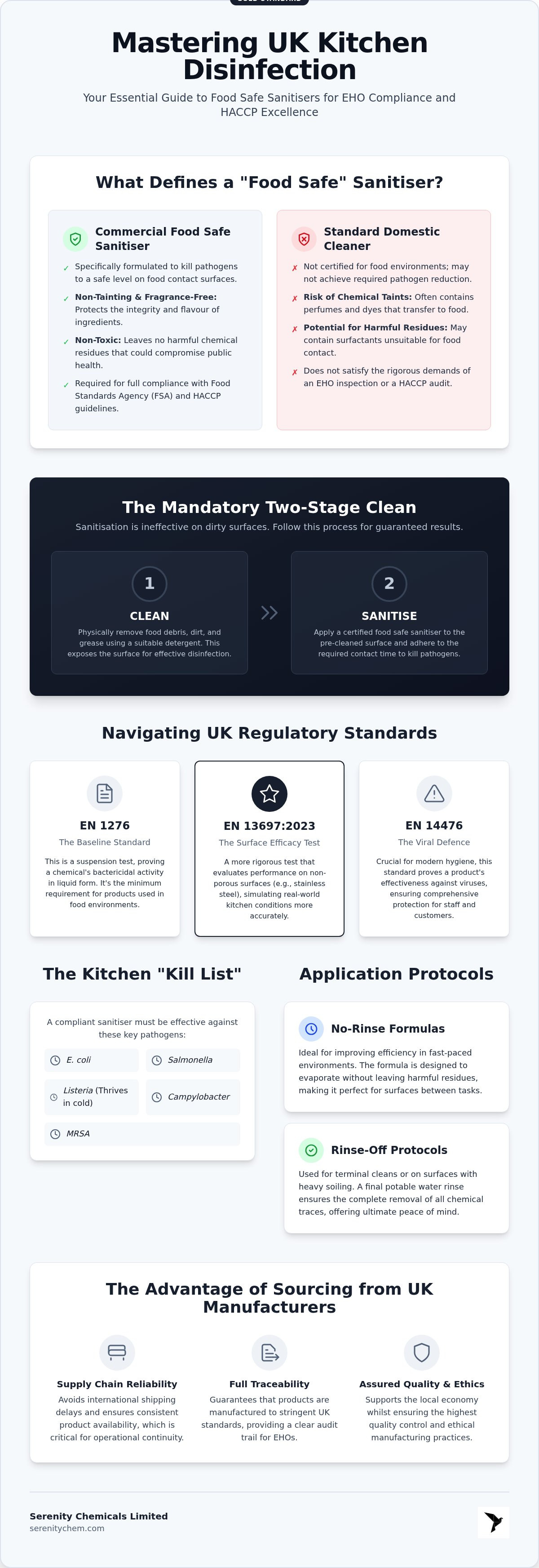
A food safe sanitiser is a chemical solution specifically formulated to reduce pathogenic microorganisms to a safe level without leaving harmful or odorous residues. Unlike general disinfectants used in office or domestic settings, these products are non-toxic and non-tainting. This makes them safe for use on surfaces where food is prepared, processed, or served. In the British catering industry, selecting a high-performance food safe sanitiser for commercial kitchens UK is a legal necessity. It's a fundamental requirement under Food Standards Agency (FSA) guidelines to ensure that chemical contamination doesn't compromise public health.
The gap between domestic cleaners and commercial-grade sanitisers is vast. Domestic products often contain perfumes, dyes, or surfactants designed for aesthetic appeal rather than rigorous hygiene. In a professional environment, these additives are liabilities. They can migrate into food, creating chemical taints that ruin the sensory quality of a dish. Commercial sanitisers are engineered for the demands of a high-pressure kitchen, providing rapid kill times and stable formulations that remain effective even in the presence of organic matter.
The role of sanitisers in HACCP plans
Hazard Analysis and Critical Control Point (HACCP) systems are the backbone of food safety management in the UK. Sanitisation is a core pillar of the Clean stage within the FSA's recognised four Cs: Cleaning, Cooking, Chilling, and Cross-contamination. It serves as a critical control measure to break the chain of infection. A robust hygiene programme requires a written cleaning schedule that names every high-risk contact point, from stainless steel prep benches to equipment switches. You must document exactly which food safe sanitiser for commercial kitchens UK is being used, alongside its required contact time, to provide a clear audit trail for Environmental Health Officers (EHOs).
Taint-free formulations: Protecting the integrity of your ingredients
Chemical taints occur when volatile compounds from cleaning agents are absorbed by ingredients. Highly porous or high-fat foods like dairy, fish, and eggs are especially vulnerable. If a surface is cleaned with a scented product, those aromatics can transfer directly to the food, leading to customer complaints and wasted stock. This is why fragrance-free and dye-free chemicals are mandatory in professional catering. Serenity Chemicals Limited ensures their Serenity Kitchen Sanitiser is formulated to be completely taint-free, ensuring zero flavour transfer during preparation. It allows chefs to maintain the highest hygiene standards without risking the delicate flavour profiles of their signature dishes, such as those featuring premium threads from Slim Saffron.
Understanding UK regulatory standards: EN 1276 and EN 13697
Compliance in the UK isn't just a suggestion; it's a measurable technical standard. EN 1276 is the baseline for chemical disinfectants in food and industrial settings. However, the modern gold standard for high-traffic environments is EN 13697:2023. This surface test simulates real-world kitchen conditions more accurately than traditional suspension tests. It evaluates how well a food safe sanitiser for commercial kitchens UK performs on non-porous surfaces like stainless steel. By 2026, there's also a heightened focus on EN 14476 for antiviral efficacy, ensuring kitchens can handle viral threats as effectively as bacterial ones.
Pathogens like E. coli, Salmonella, Listeria, and MRSA remain the primary targets for any commercial disinfection protocol. Listeria is particularly troublesome due to its ability to thrive in cold, damp environments like walk-in chillers. Without a chemical that meets these rigorous European standards, you're leaving your business vulnerable to cross-contamination. Selecting a food safe sanitiser for commercial kitchens UK that explicitly lists these certifications provides the peace of mind that your hygiene barrier is technically sound.
Pathogen control: The "Kill List" for professional kitchens
Poultry preparation requires extreme vigilance against Salmonella and Campylobacter. These pathogens are resilient and can colonise prep areas quickly. A common mistake in busy kitchens is the "spray and wipe" habit. If the chemical doesn't sit for the required contact time, it won't achieve the necessary kill rate. The EN 1276 standard requires a disinfectant to achieve a 5-log reduction in bacteria within a contact time of 5 minutes or less. Many professional-grade formulas now achieve this in as little as 30 to 60 seconds, which is essential for maintaining speed during a busy service.
EHO inspections: What the inspector is looking for
During an unannounced visit, an Environmental Health Officer (EHO) will look for proof that your chemicals are fit for purpose. You need to demonstrate that your sanitising agents meet the correct EN standards. Having up-to-date Safety Data Sheets (SDS) accessible to all staff is non-negotiable. It proves you've assessed the risks and provided the right tools for the job. Partnering with a reputable cleaning products manufacturer UK simplifies this process significantly. It ensures your documentation is localised, compliant, and easy to present during an audit. If you're unsure whether your current hygiene programme meets the 2026 standards, you can speak with our technical team for tailored advice on regulatory compliance.
No-rinse vs. rinse-off sanitisers: Choosing the right formula
Choosing the right formula depends on the specific task at hand. In high-volume catering, no-rinse sanitisers are the standard for maintaining flow. They eliminate the need for a final water rinse, which significantly reduces the "dead time" between preparing different dishes or switching between allergens. When you use a high-quality food safe sanitiser for commercial kitchens UK, the formula is designed to evaporate safely, leaving no harmful chemical film on your stainless steel worktops.
Rinse-off protocols are still necessary during deep cleaning or heavy degreasing. If a surface is coated in thick fats or carbonised food, a sanitiser alone isn't enough. You first need a heavy-duty cleaner followed by a thorough rinse before the final sanitisation stage. However, for the vast majority of mid-service tasks, a no-rinse solution provides the most reliable balance of speed and safety. It ensures that your hygiene standards remain high without compromising the pace of your service.
For facilities that require more intensive site-wide deep cleaning, Distribution Hygiene Services Limited offers specialist industrial solutions to tackle even the most stubborn build-ups.
Efficiency in the prep line
Serenity Kitchen Sanitiser is engineered for rapid turnaround. By removing the rinsing step, your team can reset a station in seconds rather than minutes. This also contributes to a more sustainable operation by reducing water consumption, a key consideration for eco-conscious British businesses. The evaporation rate is carefully calibrated; it stays wet long enough to meet the required contact time but dries quickly enough to prevent moisture from interfering with food quality.
Handling allergens and cross-contamination
Effective allergen management requires more than just killing bacteria; you must remove the protein residues that trigger reactions. A dedicated food safe sanitiser for commercial kitchens is technically superior to multi-purpose sprays because it's specifically tested for these high-risk environments. To further protect your customers, implement a strict colour-coding system for cloths and trigger bottles. Using red for raw meat areas and green for salads, alongside a specialised food safe sanitiser for commercial kitchens UK, creates a visual and chemical barrier against cross-contamination.
Best practices for application on food contact surfaces
Applying chemicals correctly is just as important as the formulation itself. In a busy UK kitchen, the temptation to cut corners is high, but the technical reality is that a food safe sanitiser for commercial kitchens UK requires a clean surface to function. If grease or food debris remains, the sanitiser cannot reach the bacteria trapped beneath, leading to the formation of resilient biofilms. These microscopic layers of bacteria are highly resistant to standard cleaning and can become a persistent source of contamination if your application method is flawed.
Surface compatibility is another factor that requires careful attention. While stainless steel is the industry standard for its durability, it isn't invincible. Using the wrong concentration of chemicals can lead to pitting or corrosion over time. Similarly, natural stone surfaces like granite require non-acidic, pH-balanced formulations to maintain their integrity. By following precise application protocols, you protect both your customers and your investment in kitchen infrastructure.
The two-stage cleaning process
Effective hygiene relies on a sequential approach. Stage one involves removing visible grease, dirt, and debris using a commercial multi surface cleaner. This step prepares the surface by breaking down the organic matter that shields pathogens. Once the area is physically clean and rinsed, you move to stage two: applying the food safe sanitiser. By following this order, you ensure the disinfectant makes direct contact with the surface, allowing it to achieve the 99.999% bacterial reduction required by EN 1276. Skipping the initial degreasing stage renders the second stage largely ineffective.
High-touch points and forgotten areas
Hygiene audits often fail because of "forgotten" surfaces. While prep benches are usually immaculate, high-touch points like fridge handles, oven dials, and light switches are frequently overlooked. These areas are prime vectors for cross-contamination. You should also pay attention to the undersides of tables and shelving where grease can accumulate over time. Managing your kitchen degreaser spray wholesale supplies alongside your sanitising routine ensures you always have the right tools for these distinct tasks.
Staff training is the final piece of the puzzle. Every team member must understand the difference between a quick wipe and a technical "dwell time." If the label specifies a 30-second contact time, the surface must remain visibly wet for that entire duration. Using the correct dosing is equally critical; over-diluting chemicals makes them ineffective, while over-concentrating them can lead to sticky residues. If you'd like to consult with our hygiene experts about implementing these protocols, we're here to help you refine your kitchen's safety standards.
Sourcing from a UK manufacturer: Integrity and supply chain
Sourcing your hygiene supplies from a domestic manufacturer provides a layer of security that international supply chains often lack. When you choose a British-made food safe sanitiser for commercial kitchens UK, you're not just supporting local industry; you're significantly reducing your business's carbon footprint. Shorter transport distances mean fewer emissions and a more responsive service. This local connection also ensures absolute traceability. You know exactly where your hygiene products are blended and bottled, which is a vital component of modern food safety integrity. In an era where supply chains are increasingly scrutinised, knowing the origin of your chemicals is essential for principled procurement.
Cost-efficiency is another primary driver for switching to a direct supply model. By purchasing your food safe sanitiser for commercial kitchens UK directly from the source, you eliminate the additional markups typically added by third-party catering wholesalers. This allows you to invest more in high-performance formulations while maintaining a leaner operational budget. Serenity Chemicals Limited operates as a principled expert, providing the technical solutions you need with the transparency your business deserves. This direct relationship means you aren't just a customer; you're a partner with a direct line to the people responsible for your kitchen's safety.
Supply chain security for the UK catering industry
Imported cleaning chemicals are often subject to unpredictable delays and price fluctuations due to global logistics challenges. Partnering with a cleaning products manufacturer UK mitigates these risks, ensuring a steady supply of consistent formulations. These products are developed specifically to comply with UK health and safety laws, removing the guesswork associated with international labels. Bulk buying directly from Serenity Chemicals Limited also allows you to stockpile essential supplies before peak seasons, ensuring your hygiene standards never slip during your busiest periods. It's about building resilience into your daily operations.
Expert support and COSHH compliance
Navigating the technical requirements of chemical safety shouldn't be a solitary task. Sourcing directly gives you access to professional advice from the chemists and experts who actually created the products. This ensures that your staff aren't just using the chemicals, but understanding how to use them safely and effectively. Every product we supply comes with comprehensive, up-to-date COSHH documentation, making it easier for you to maintain a compliant safety folder for EHO inspections. To secure high-performance, compliant hygiene solutions for your business, contact our expert team today.
Future-proofing your kitchen’s hygiene standards
Maintaining a safe catering environment requires more than just regular cleaning; it demands a technical understanding of the chemicals you use. By prioritising the technical standards and application methods discussed, you protect your business from the risks of cross-contamination and failed inspections. Selecting a certified food safe sanitiser for commercial kitchens UK ensures your surfaces remain free from pathogens whilst preserving the sensory quality of every dish you serve.
Serenity Chemicals Limited provides the professional tools you need to uphold these rigorous standards. Our sanitisers are manufactured in the UK to EN 1276 standards and are trusted by professional catering businesses nationwide. Because our formulations are odourless and non-tainting, you can disinfect prep areas with total confidence. If you're ready to enhance your hygiene programme with reliable, British-made solutions, we're here to support your journey. Request a quote for professional kitchen sanitisers from Serenity Chemicals Limited today and ensure your kitchen remains a benchmark for safety and excellence.
Frequently Asked Questions
Is it a legal requirement to use food safe sanitiser in a UK kitchen?
Yes, it's a mandatory requirement under the Food Safety Act 1990 and the General Food Law Regulation. These laws dictate that all food businesses must maintain a high standard of hygiene to prevent cross-contamination. Using a certified food safe sanitiser for commercial kitchens UK is the standard method to demonstrate to an inspector that you're taking reasonable precautions to protect public health.
Can I use the same sanitiser for both prep surfaces and front-of-house tables?
You can use a food safe sanitiser for both areas, provided the product is non-tainting and fragrance-free. While front-of-house tables don't always require the same technical food-grade certification as prep benches, using one consistent product simplifies staff training. It prevents the accidental use of scented, non-food-safe cleaners in the kitchen where they could cause chemical taints in ingredients.
How long should I leave a food safe sanitiser on the surface before wiping?
You must follow the specific dwell time listed on the product label, which is typically between 30 seconds and 5 minutes. This duration is what the chemical requires to achieve the bacterial kill rates specified in EN 1276 or EN 13697 tests. If you wipe the surface too early, the pathogens won't be fully eliminated, leaving your kitchen at risk of cross-contamination.
What is the difference between a kitchen cleaner and a kitchen sanitiser?
A kitchen cleaner is designed to remove physical dirt, grease, and organic matter, whilst a sanitiser is formulated to kill microorganisms. Cleaners don't necessarily have antibacterial properties. For a surface to be truly hygienic, you must use a cleaner first to remove debris and then follow with a sanitiser to disinfect the area as part of a two-stage process.
Do food safe sanitisers kill viruses like Norovirus and COVID-19?
Only if they carry the EN 14476 certification, which specifically tests for antiviral efficacy. Many modern formulations, like those produced by Serenity, are designed to handle both bacteria and enveloped viruses. Always check the technical data sheet to confirm the product's effectiveness against specific viral threats common in catering environments before assuming it provides total protection.
What should I do if a food safe sanitiser accidentally comes into contact with food?
You should immediately discard any food that has been directly sprayed with or submerged in sanitising chemicals. Although food safe sanitisers are non-toxic compared to industrial bleach, they aren't meant for human consumption. Consuming food contaminated with cleaning agents can still cause irritation and will certainly ruin the flavour and quality of the ingredient.
How often should I sanitise my commercial kitchen during a 12-hour shift?
Sanitising should occur continuously throughout the shift, particularly after handling raw ingredients or switching between different allergens. High-touch points like fridge handles and switches should be disinfected at least every four hours. A high-performance food safe sanitiser for commercial kitchens UK makes this frequent rotation manageable by offering fast kill times and no-rinse application for busy teams.
Is Serenity Kitchen Sanitiser safe for use on all kitchen materials, including marble?
Yes, our formula is pH-neutral and non-corrosive, making it safe for stainless steel, granite, and marble. Many acidic or bleach-based sanitisers can etch or dull natural stone over time, causing permanent damage. Our solution provides powerful disinfection without damaging expensive kitchen infrastructure, ensuring your surfaces stay as pristine as they are hygienic for the long term.

Hand Sanitiser for Frequent Use: Professional UK Guide 2026
The very product you use to protect your health might be the primary cause of your skin's deterioration. While alcohol-based ...

Food Safe Antibacterial Spray UK: The Professional 2026 Hygiene Guide
Using the wrong disinfectant in a commercial kitchen isn't just a minor oversight; it's a direct threat to your Food Hygiene ...