
Your kitchen passed last night's clean with flying colours, yet the moment a customer walks through the door, that unmistakable stench of stale cooking oil hits them first. Sound familiar? The frustrating truth is that a standard mop-down and a spray of domestic cleaner won't solve this problem, because grease odours aren't simply floating in the air. They're anchored to every surface by a microscopic lipid film, and only a professional-grade heavy duty degreaser for commercial kitchen grease has the chemical strength to break that bond at its source.
You're right to be concerned. A persistent grease smell isn't just unpleasant for diners; it's a signal to local authority inspectors that your cleaning regime may not be meeting the standards required of a commercial food environment. Domestic products simply aren't formulated for the volume or intensity of industrial cooking residue, which is precisely why so many operators find themselves fighting the same battle night after night.
This guide sets out the professional chemical protocols that actually eliminate stubborn grease odours for good, covering the correct products, application methods, and hygiene routines you need to keep your kitchen fresh, compliant, and ready to impress.
Key Takeaways
- Grease odours persist because cooking releases airborne lipid aerosols that settle and bond to every surface in your kitchen, forming a microscopic film that traps bacteria and organic matter - and that no standard domestic cleaner can fully remove.
- Air fresheners and scented sprays only mask the problem; true odour elimination requires a professional heavy duty degreaser for commercial kitchen grease that uses surfactant chemistry to emulsify and lift the lipid film at its source.
- The worst offenders are often invisible - neglected extraction filters, porous grout lines, and high ceiling surfaces are the three hidden grease traps most commonly overlooked during routine cleaning.
- A structured, step-by-step degreasing protocol - applied to the right surfaces in the correct sequence - is what separates a kitchen that smells clean from one that genuinely is clean and inspection-ready.
- Sourcing your cleaning chemicals directly from a UK manufacturer ensures you receive professional-grade formulations built for commercial volumes, rather than diluted supermarket alternatives that fall short under real kitchen conditions.
Why Grease Odours Persist in Commercial Kitchens
Most kitchen operators assume that if a surface looks clean, it is clean. That assumption is where the problem begins. Grease odours in commercial kitchens aren't a housekeeping failure; they're the result of a specific chemical process that unfolds every time you fire up the fryer or run a busy service. Understanding that process is the first step towards solving it permanently.
When fats and oils are heated to cooking temperatures, they don't simply stay in the pan. They partially vaporise, releasing microscopic lipid particles into the surrounding air. These aerosols travel on convection currents, dispersing throughout the kitchen and settling on every available surface: walls, ceilings, ventilation grilles, light fittings, and equipment housings. Once deposited, they cool rapidly and form a thin, sticky film that bonds to whatever it lands on.
This film is the root cause of persistent kitchen odours, and it's invisible to the naked eye. Standard cleaning products can't shift it because they weren't designed to. That's where a professional heavy duty degreaser for commercial kitchen grease becomes essential rather than optional.
The Role of Airborne Lipids
High-heat cooking methods, particularly deep frying, wok cooking, and chargrilling, are especially efficient at generating lipid aerosols. The hotter the cooking surface, the finer and more widely distributed these particles become. Humidity compounds the problem considerably. In a busy kitchen where steam and heat combine, moisture acts as a carrier, helping fat particles travel further and penetrate porous surfaces such as grout lines, uncoated brickwork, and ceiling tiles. The result is a grease film that isn't confined to the cooking zone; it's distributed across the entire room.
Grease as an Odour Anchor
Once the lipid film has settled, it behaves like an adhesive. Dust, airborne skin cells, food debris, and bacteria all become trapped within it, creating a layered deposit that compounds over time. Left undisturbed, the fats within this layer begin to oxidise, a process known as rancidification. It's this oxidation that produces the sharp, stale, unpleasant smell that no amount of ventilation or air freshener can neutralise.
Rancidification is also a hygiene concern that extends well beyond odour. The organic matter anchored within the grease film provides a nutrient-rich environment for bacterial growth, which carries direct implications for food safety compliance and your hygiene rating. Temperature fluctuations accelerate the issue further: as the kitchen heats up during service and cools overnight, the grease film expands and contracts, releasing volatile organic compounds that intensify the stale smell each morning.
Domestic cleaners fail at this point because their surfactant concentrations are formulated for household residues, not the polymerised, oxidised grease layers that build up in a commercial environment. They emulsify surface-level soiling whilst leaving the deeper lipid film entirely intact, which is precisely why the smell returns within hours of cleaning.
The Science of Removal: Degreasing vs Masking
Recommending diffusers as a solution to commercial kitchen odours, as some suppliers do, reflects a fundamental misunderstanding of the problem. Essential oils don't interact with polymerised grease deposits. They layer on top of them, creating a heavier, more cloying atmosphere that experienced inspectors will see through immediately. Genuine odour elimination requires chemistry, not fragrance.
How Industrial Degreasers Emulsify Fats
The active agents in a professional heavy duty degreaser for commercial kitchen grease are surfactants, molecules with a dual structure that makes them uniquely effective against lipid deposits. One end of the molecule, the hydrophilic head, is attracted to water. The other end, the lipophilic tail, is attracted to fats and oils. When a surfactant solution contacts a grease film, the lipophilic tails embed themselves into the fat whilst the hydrophilic heads remain orientated towards the water phase. This action lifts the grease away from the surface, surrounding it in microscopic droplets that can be rinsed cleanly away.
Emulsification, the process of dispersing one liquid uniformly through another, is the critical step that converts a bonded grease deposit into a water-soluble waste product that can be removed entirely. No amount of scrubbing with a domestic product achieves this at depth, because the surfactant concentrations in household cleaners simply aren't sufficient for oxidised, carbonised commercial residue.
For heavily carbonised deposits on surfaces such as oven interiors, extraction canopies, and fryer surrounds, alkaline cleaners provide an additional chemical mechanism. High-pH formulations break down the carbon bonds within burnt-on grease through saponification, converting the fatty acids into water-soluble soaps. This is why professional degreasing products are formulated at a higher alkalinity than anything available in a supermarket aisle.
It's also worth addressing natural remedies directly. Vinegar is mildly acidic and effective against limescale and some surface bacteria. It has no meaningful action on polymerised fat deposits and is entirely unsuitable as a primary degreasing agent in a commercial kitchen environment.
Why Air Purifiers Alone Are Insufficient
Ozone generators and HEPA filtration units have a legitimate role in a well-managed kitchen environment, but that role is secondary. Ozone can neutralise some volatile organic compounds in the air, and quality filtration will capture airborne particulates. Neither technology removes the grease film from your walls, ceilings, or extraction ducting. As long as that film remains intact, it will continue to off-gas rancid compounds every time the kitchen warms up, rendering any air purification effort temporary at best.
The correct philosophy is straightforward: clean first, purify second. Eliminate the source with a correctly applied degreasing protocol, then use ventilation and filtration to maintain air quality between deep cleans. Reversing that order is the reason so many operators find themselves in an endless cycle of air fresheners and persistent odour complaints.
If you're uncertain which formulation is appropriate for your specific surfaces and soiling levels, speaking with the team at Serenity Chemicals is a practical first step towards getting the chemistry right from the outset.
Hidden Grease Traps: Where the Smells Are Hiding
Most kitchen operators clean what they can see. The problem is that the worst grease accumulation happens precisely where daily cleaning routines don't reach. If your kitchen still smells stale after a thorough clean, the source almost certainly isn't the surfaces you've just wiped down. It's the ones you haven't touched in weeks.
Extractor Fans and Ductwork
Extraction systems are designed to draw grease-laden air out of the kitchen, which means they absorb enormous quantities of lipid aerosols over time. Baffle filters and grease traps become progressively saturated, and once they reach capacity, they stop filtering effectively and begin recirculating contaminated air back through the building. That stale cooking smell drifting into your dining area? In many cases, it's being actively pumped there by a choked extraction system.
There's a more serious concern beyond odour. Grease accumulation inside ductwork is a recognised fire hazard; a heavily soiled duct can ignite from a single flash of heat travelling up from the cooking line. Extraction components require regular degreasing with a professional heavy duty degreaser for commercial kitchen grease, applied with sufficient dwell time to penetrate baked-on deposits. Once the grease has been lifted and rinsed clear, following up with a professional food safe sanitiser eliminates the bacterial residue that degreasing alone leaves behind.
Porous Surfaces and Grout Lines
Tile grout is one of the most consistently overlooked surfaces in a commercial kitchen. Its porous structure absorbs lipid aerosols and moisture simultaneously, creating a warm, nutrient-rich environment deep within the grout line itself. A standard mop passes over the surface without penetrating these pores, which is why grout lines can harbour months of accumulated grease even in kitchens that appear well maintained.
Effective treatment requires a dedicated approach:
- Apply a heavy-duty floor cleaner directly to the grout lines and allow adequate dwell time for the surfactants to penetrate.
- Agitate with a stiff-bristled scrubbing brush rather than a mop, working the solution into the pores rather than across them.
- Rinse thoroughly to remove the emulsified grease rather than simply redistributing it across the floor surface.
Ceilings and Vertical Surfaces
Heat rises, and it carries grease with it. The upper third of your kitchen walls and the ceiling itself accumulate lipid deposits that are rarely addressed during routine cleaning. Operators frequently diagnose a floor or equipment problem when the smell is actually descending from above, where oxidising grease has been off-gassing unnoticed for months.
Cleaning at height requires a long-reach application method: a diluted degreasing solution applied via a trigger spray with an extended lance, allowed to dwell, and then wiped down systematically. Walls behind cooking equipment and around light fittings are particularly prone to heavy build-up and should be treated as priority surfaces rather than afterthoughts. Non-food contact surfaces carry no less responsibility when it comes to odour control and inspection readiness.
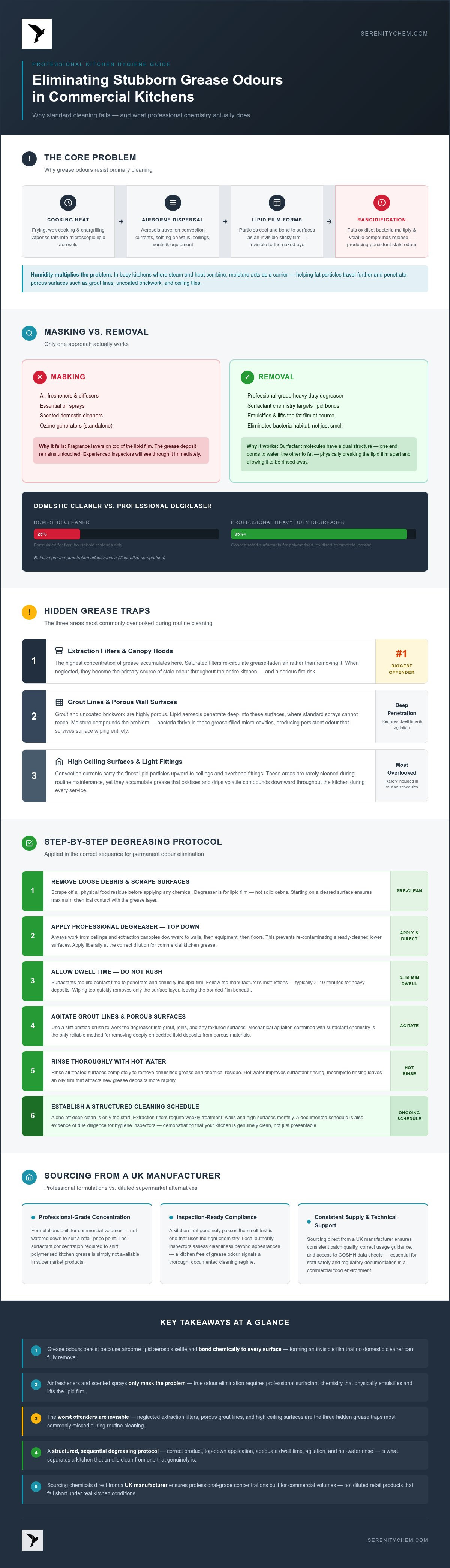
A Step-by-Step Protocol for Grease Odour Elimination
Understanding why grease odours persist is half the battle. Acting on that knowledge with a structured, repeatable protocol is the other half. What follows is a practical sequence that removes the guesswork from degreasing and gives your team a clear, consistent method to follow every time.
Step 1: Prepare the area. Before any chemical is applied, clear food items from all surfaces and ensure they're safely stored or covered. This isn't simply good practice; it's a food safety requirement. Any degreasing agent applied in a food preparation environment must be used in accordance with its product data sheet, and that means eliminating the risk of cross-contamination from the outset.
Step 2: Apply the degreaser systematically. Working from high surfaces downward, apply your heavy duty degreaser for commercial kitchen grease to all high-contact and high-accumulation zones: extraction canopies, wall tiles behind cooking equipment, equipment housings, and fryer surrounds. Spraying top-to-bottom prevents cleaned surfaces from being re-soiled by drips from above.
Step 3: Allow adequate dwell time. This is the step most operators rush, and it's where the chemistry actually happens. Dwell time is the period during which surfactants penetrate and emulsify the lipid film. Cutting it short means you're wiping away partially loosened grease rather than removing it entirely. Always follow the manufacturer's stated contact time for the specific formulation you're using.
Step 4: Agitate stubborn deposits. For carbonised or heavily polymerised areas, a stiff-bristled brush is essential. Mechanical agitation breaks the surface tension between the grease deposit and the substrate, allowing the emulsified fats to be lifted cleanly rather than smeared across the surface.
Step 5: Rinse thoroughly. Warm water removes the emulsified grease along with any chemical residue. A thorough rinse is non-negotiable; leaving degreaser on a surface doesn't improve results and can compromise food safety compliance.
Daily vs Deep Cleaning Schedules
Not every task belongs on the nightly checklist. Daily cleaning should address floors, prep surfaces, and cooking equipment contact points. Incorporating a commercial floor cleaner into the nightly routine prevents the gradual build-up of lipid residue that, over time, polymerises into a varnish-like layer that daily mopping alone can't shift. Weekly deep cleans should extend to extraction filters, ceiling surfaces, and grout lines. Consistency is the operative word here: a daily routine that's genuinely followed prevents the conditions that make deep cleaning so labour-intensive in the first place.
Selecting the Right Chemical Strength
A multi-surface cleaner is appropriate for daily maintenance on lightly soiled prep areas. For baked-on deposits, heavily soiled extraction components, or surfaces that haven't been deep-cleaned in some time, a concentrated heavy-duty formulation is the correct choice. Dilution ratios matter considerably; using too weak a solution leaves grease partially emulsified, whilst using too strong a concentration on the wrong surface can cause material damage. Using the wrong concentration entirely, particularly under-diluting a product and then failing to rinse properly, can leave a sticky chemical residue on surfaces that actively attracts airborne grease particles, compounding the very problem you're trying to solve. Always dilute to the manufacturer's specification and adjust only when the soiling level genuinely warrants it.
If you'd like guidance on which Serenity Chemicals formulation is best matched to your kitchen's specific surfaces and soiling levels, get in touch with the team directly for straightforward, product-specific advice.
Sourcing Professional Solutions from a UK Manufacturer
Where you source your cleaning chemicals matters as much as which chemicals you choose. Buying direct from a UK-based manufacturer like Serenity Chemicals removes a layer of uncertainty that comes with supermarket or cash-and-carry alternatives: you know exactly what's in the formulation, how it's been tested, and who to contact when you need product-specific guidance. That transparency is difficult to replicate through a retail supply chain.
Supermarket degreasers are blended for domestic use at domestic volumes. The surfactant concentrations, alkalinity levels, and dwell-time requirements are calibrated for a household oven, not a commercial extraction canopy or a fryer surround that's seen three services a day for six months. A professional heavy duty degreaser for commercial kitchen grease, formulated specifically for catering environments, is a categorically different product, and sourcing it from the manufacturer ensures you're receiving a consistent, uncompromised formulation every time.
Keeping your chemical inventory organised is a practical challenge in any busy kitchen. A structured professional cleaning chemicals list helps operators map the right product to each task, preventing the common mistake of using a multi-surface cleaner where a heavy-duty formulation is required, or over-applying a concentrated product where a diluted solution would suffice. Getting that inventory right from the outset reduces waste, improves results, and simplifies staff training.
Compliance and Safety Standards
Professional chemical manufacturers supply full COSHH (Control of Substances Hazardous to Health) data sheets with every product. These documents aren't administrative paperwork; they're the foundation of a legally compliant cleaning regime. They specify safe handling procedures, correct dilution ratios, personal protective equipment requirements, and first-aid measures, giving your team the information they need to use each product correctly and safely. Serenity Chemicals' formulations are developed with food preparation environments in mind, balancing the high-alkalinity chemistry needed to break down commercial grease deposits with the safety standards required for use around food contact surfaces. That balance reflects a genuine commitment to responsible manufacturing rather than a marketing claim.
Economic Benefits of Bulk Procurement
For high-volume kitchens, bulk procurement of concentrated solutions delivers a meaningful reduction in cost per litre compared with buying ready-to-use products in smaller quantities. Concentrated formats also reduce packaging waste considerably; a single large container of degreaser concentrate, diluted on-site to the correct ratio, replaces multiple smaller bottles and the associated plastic disposal. It's a more efficient model operationally and a more responsible one environmentally.
The Serenity Heavy Duty Degreaser sits at the centre of a well-managed kitchen cleaning regime, providing the chemical strength to eliminate stubborn grease deposits and the odours they produce, without compromising the safety standards that commercial food environments demand.
View the Serenity range of industrial degreasers and kitchen sanitisers to find the right formulation for your kitchen's specific requirements.
A Fresher Kitchen Starts with the Right Chemistry
Persistent grease odours aren't a housekeeping problem; they're a chemistry problem. The lipid film responsible for that stale, rancid smell won't respond to air fresheners, domestic sprays, or good intentions. Only a professional heavy duty degreaser for commercial kitchen grease, applied correctly and consistently, removes the source rather than masking it.
Three principles matter most: treat the surfaces you can't see as well as those you can, allow your degreaser the dwell time it needs to work at depth, and source your chemicals from a UK manufacturer whose formulations are built for commercial volumes. Serenity Chemicals' HACCP-aligned cleaning solutions are trusted by catering professionals nationwide precisely because they deliver on both efficacy and food safety standards.
Your kitchen deserves a cleaning regime that matches the demands you put on it. Get in touch with the Serenity Chemicals team today to find the right formulations for your kitchen's specific requirements. A genuinely fresh, inspection-ready kitchen is well within reach.
Frequently Asked Questions
Why does my kitchen still smell like grease after mopping the floors?
Mopping addresses surface-level soiling but doesn't penetrate the microscopic lipid film that bonds to floors over time. Standard mop solutions lack the surfactant concentration needed to emulsify oxidised grease deposits, so the film remains intact and continues producing odour. The smell often intensifies as the kitchen warms up during service, releasing volatile compounds from grease that mopping simply redistributed rather than removed.
The fix is to incorporate a dedicated commercial floor cleaner into your nightly routine, applied with adequate dwell time before agitation and rinsing. Grout lines in particular require a stiff-bristled brush rather than a mop head to draw the emulsified grease out of the pores rather than across them.
Can I use vinegar to get rid of heavy grease odours in a restaurant?
Vinegar isn't an effective solution for heavy grease odours in a commercial kitchen. It's mildly acidic, which makes it useful against limescale and some surface bacteria, but it has no meaningful chemical action on polymerised or oxidised fat deposits. Applying vinegar to a greasy extraction canopy or fryer surround won't emulsify the lipid film; it will simply wet the surface and evaporate, leaving the source of the odour entirely intact.
A professional heavy duty degreaser for commercial kitchen grease uses high-concentration surfactants and, in many formulations, alkaline chemistry to break down the fat deposits that vinegar cannot touch. For a restaurant environment, there's no practical substitute for a product that's been formulated specifically for commercial soiling levels.
How often should I clean my extraction filters to prevent smells?
The correct frequency depends on your cooking volume and methods, but as a general guide, baffle filters in a busy commercial kitchen should be removed and degreased weekly. High-volume operations running deep fryers or chargrills may need to address filters more frequently than that. Once filters become saturated, they stop capturing grease-laden air effectively and begin recirculating contaminated air through the building, which is a common cause of persistent odours in dining areas.
After degreasing, follow up with a food-safe sanitiser to eliminate the bacterial residue that accumulates within the filter structure. Keep a written log of filter cleaning dates; this demonstrates due diligence to inspectors and helps you identify whether your current schedule is sufficient for your kitchen's output.
Is it safe to use heavy-duty degreasers on food preparation surfaces?
It depends on the specific product and whether it's been formulated for use in food environments. A professional heavy duty degreaser for commercial kitchen grease should always be accompanied by a full COSHH data sheet that specifies which surfaces it's approved for, the correct dilution ratio, and the rinsing requirements before food contact surfaces are returned to use. Never assume a product is food-safe based on labelling alone; verify it against the manufacturer's documentation.
The standard protocol for food contact surfaces is to degrease, rinse thoroughly with clean water to remove all chemical residue, and then apply a dedicated food-safe sanitiser as a separate step. Degreasing and sanitising are distinct processes that serve different purposes; one removes the grease film, the other eliminates the bacteria. Both are necessary, and neither replaces the other.
What is the best way to remove grease smells from kitchen walls and ceilings?
The most effective approach is a systematic top-down application of a diluted degreasing solution, applied via a trigger spray with an extended lance for ceiling surfaces. Allow the product sufficient dwell time to penetrate the lipid film before wiping down with a clean cloth or sponge. Work in sections to prevent the solution from drying on the surface before you can remove the emulsified grease. Pay particular attention to the wall area directly behind and above cooking equipment, where aerosol deposition is heaviest.
Ceiling surfaces and the upper third of walls are often the primary source of stale odours in kitchens that appear otherwise well-maintained. Including them in a monthly deep-clean schedule, rather than treating them as occasional tasks, prevents the gradual build-up that makes the job significantly more labour-intensive over time.
Does a grease trap cause bad smells in the dining area?
Yes, a poorly maintained grease trap is a frequent and often overlooked source of foul odours that can migrate from the kitchen into customer-facing areas. Grease traps work by intercepting fats, oils, and grease before they enter the drainage system, but the accumulated material begins to decompose if the trap isn't emptied and cleaned at appropriate intervals. That decomposition produces hydrogen sulphide and other compounds responsible for the distinctive rotten smell associated with neglected drainage.
Grease trap maintenance frequency varies with kitchen output, but the trap should be inspected regularly and emptied before it reaches capacity. Chemical degreasing products can assist with cleaning the trap housing and surrounding pipework, though the disposal of intercepted grease must be handled in accordance with local authority requirements. If odours are reaching the dining area, the trap should be your first point of investigation.
How do I know if a cleaning chemical is food-safe for my restaurant?
The most reliable indicator is the product's COSHH data sheet, which a reputable UK manufacturer will supply with every product. This document specifies the intended application surfaces, safe dilution ratios, contact times, and any restrictions on use near food or food contact surfaces. Products formulated for use in food preparation environments will state this explicitly, along with the rinsing requirements that must be followed before surfaces are returned to use.
Buying directly from a UK manufacturer rather than through a retail supply chain gives you direct access to accurate, up-to-date documentation and the ability to ask product-specific questions before purchasing. If a supplier can't provide a full data sheet for a cleaning product you're using in a food environment, that's a significant compliance concern that warrants switching to a more transparent source.
Can airborne grease affect my restaurant's hygiene rating?
It can, and inspectors are trained to look for the evidence. A persistent grease odour, visible lipid film on walls or ceilings, saturated extraction filters, and soiled grout lines all indicate that a cleaning regime isn't maintaining the standards required of a commercial food environment. These findings don't just affect the aesthetic impression; they raise legitimate concerns about bacterial contamination and fire safety that are reflected directly in your hygiene score.
Local authority inspectors assess the overall cleanliness of the premises, not just food contact surfaces. A kitchen that smells clean and one that genuinely is clean aren't always the same thing, but a well-structured degreasing protocol applied consistently to all surfaces, visible and hidden alike, is what closes that gap and keeps your rating where it needs to be.

Hand Hygiene in Food Preparation Areas: The 2026 Professional Guide
The Food Standards Agency estimates that foodborne illness costs the UK economy approximately £9 billion every year, with a s...

Sanitising Commercial Kitchen Hard Surfaces: The Professional UK Guide (2026)
Did you know that the average fine for food hygiene offences in the UK has more than tripled since 2016, now reaching over £7...