

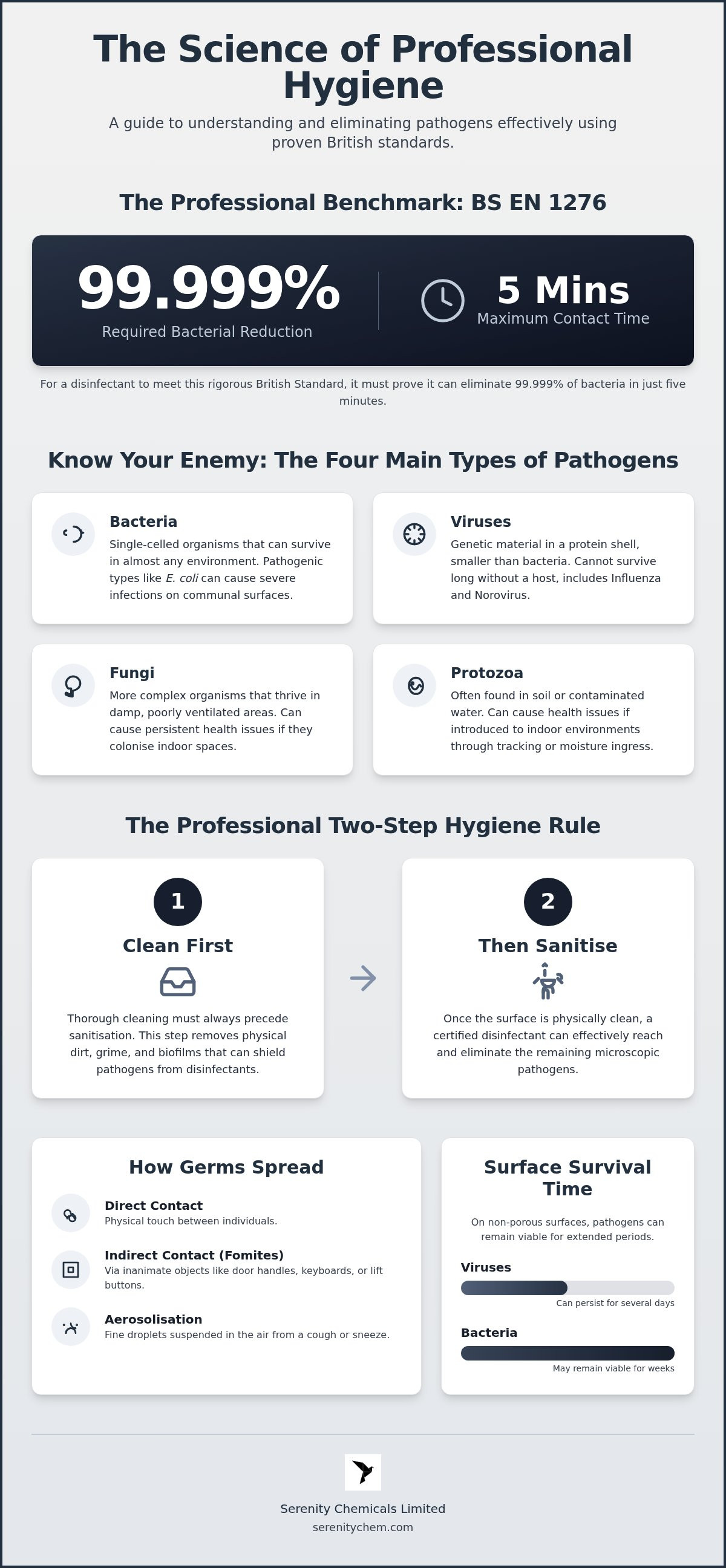
Did you know that for a disinfectant to meet the rigorous British Standard BS EN 1276, it must demonstrate a 99.999% reduction in bacteria within just five minutes? Most household cleaning routines fall significantly short of this professional benchmark, often merely relocating germs rather than actually eliminating them. It's perfectly natural to feel a sense of uncertainty when faced with rows of cleaning products, especially when the technical distinction between a virus and a bacterium remains unclear.
You deserve the peace of mind that comes from knowing your environment is genuinely safe. This guide will help you master the science of hygiene by implementing professional-grade protocols used in high-stakes commercial settings. We'll clarify the different types of pathogens you're up against and explain the British efficacy standards, such as EN 14476 for virucidal activity, that truly matter. By the end, you'll have a practical framework for choosing the right sanitisers to protect your home with confidence and integrity.
Key Takeaways
- Understand the fundamental differences between bacteria, viruses, and other microbes to target your hygiene efforts with precision.
- Identify the primary routes of transmission and learn how inanimate objects, known as fomites, facilitate the spread of germs.
- Decode British efficacy standards, such as BS EN 14476 and BS EN 1276, to ensure your chosen disinfectants are scientifically proven to perform.
- Implement a professional "Two-Step" hygiene rule by learning why thorough cleaning must always precede sanitisation for maximum protection.
- Discover how to source high-performance solutions from a UK-based manufacturer that prioritise both chemical efficacy and user safety.
Defining Germs: The Microscopic Organisms Shaping Our Environment
Microscopic organisms, or microbes, are the invisible architects of our physical world. Whilst many people use the term interchangeably with illness, the scientific reality is more nuanced. The Germ theory of disease established that specific microorganisms are the cause of certain ailments, yet the vast majority of microbes are actually beneficial or neutral. When we discuss germs, we are specifically referring to the subset of microbes known as pathogens that cause harm to their hosts.
It's vital to distinguish between an infection and a disease. An infection occurs when these microscopic invaders enter the body and begin to multiply. Disease is the subsequent stage where cells are damaged, leading to the clinical symptoms we recognise as illness. In high-traffic British commercial environments, from busy London offices to regional transport hubs, the prevalence of these pathogens necessitates a sophisticated understanding of their biology to maintain safety and operational continuity.
The Four Main Types of Pathogens
Pathogens are typically categorised into four distinct groups, each requiring different strategies for eradication:
- Bacteria: These are resilient, single-celled organisms that can survive in almost any environment. Whilst many are harmless, others like Streptococcus or E. coli can lead to severe infections if they are allowed to proliferate on communal surfaces.
- Viruses: Much smaller than bacteria, viruses are essentially genetic material wrapped in a protein capsule. They cannot survive for long without a host cell to hijack for replication. Common examples include the seasonal Influenza virus and the highly contagious Norovirus, which often causes seasonal outbreaks.
- Fungi and Protozoa: These are more complex organisms. Fungi thrive in damp, poorly ventilated areas, whilst protozoa are often found in soil or contaminated water. Both can cause persistent health issues if they colonise indoor spaces through tracking or moisture ingress.
Good vs. Bad Microbes: The Biological Balance
The Mechanics of Transmission: How Germs Spread in Professional Settings
Understanding how pathogens travel is the first step in building a truly effective defence. Transmission typically occurs through three primary channels. Direct contact involves physical touch between individuals, whilst aerosolisation happens when fine droplets remain suspended in the air following a cough or sneeze. Indirect contact, however, is often the most overlooked route. This involves "fomites"—inanimate objects such as lift buttons, shared keyboards, or door handles that act as vehicles for germs.
In the UK, indoor climates play a significant role in pathogen persistence. Damp, humid conditions can extend the life of certain bacteria, whilst the dry air found in centrally heated offices during winter can actually assist the spread of airborne viruses. Identifying high-touch points is critical for any hygiene strategy. Areas like kettle handles, printer touchscreens, and banisters require much more frequent attention than low-traffic zones. Focusing your efforts on these critical touchpoints ensures a more efficient use of resources and a higher level of protection for everyone in the building.
Surface Survival: How Long Do Germs Last?
Non-porous surfaces like stainless steel or acrylic are particularly hospitable for pathogens. Some viruses can persist for several days, whilst certain bacteria may remain viable for weeks if left undisturbed. Porous materials, such as office carpets, present a different challenge. They trap microbes deep within their fibres, necessitating specialised cleaning chemistries. If you are managing large facilities, consulting a commercial floor cleaner supplier ensures you have the correct formulations for these complex, high-traffic surfaces.
The "Hand-to-Surface" Cycle
The speed of contamination is startling. Research suggests that a single contaminated hand can transfer germs to up to 14 other surfaces in a short space of time. This creates a self-perpetuating cycle that is difficult to break with standard cleaning alone. Effective control requires a dual approach: rigorous hand hygiene and the use of residual antibacterial sprays. These sprays don't just kill on contact; they provide an ongoing layer of protection that helps prevent immediate re-contamination. For guidance on implementing these professional protocols in your specific environment, you can speak with our technical team.
Evaluating Efficacy: Understanding British Standards and Disinfection Chemistry
Professional hygiene relies on a critical distinction that is often misunderstood: the difference between cleaning and disinfecting. Cleaning involves the physical removal of dirt, grease, and organic matter from a surface. Whilst this is an essential first step, it doesn't necessarily kill the pathogens present. Disinfecting is the chemical process of eliminating germs to a safe level. If a surface isn't cleaned first, the "bio-burden" of dirt can act as a physical shield, allowing microbes to survive even when powerful chemicals are applied. For maximum effect, you must always follow a two-step process: clean to remove the debris, then sanitise to kill the remains.
When selecting products, the most reliable metric for performance is the "Log Reduction" scale. This mathematical shorthand describes how many microbes a product can eliminate. A Log 4 reduction means 99.99% of pathogens are killed, whilst a Log 5 reduction—the standard required for many professional applications—indicates a 99.999% kill rate. This small numerical difference is significant; a Log 5 product is ten times more effective than a Log 4 alternative. Choosing the right professional cleaning chemicals ensures that your facility meets these rigorous performance benchmarks rather than relying on supermarket-grade labels that may lack verified data.
The Role of EN 14476 and EN 1276 Standards
In the United Kingdom, efficacy is governed by specific British Standards. BS EN 1276 is the benchmark for bactericidal activity, proving a product can kill 99.999% of bacteria within five minutes. For protection against viruses, you must look for BS EN 14476. EN 14476 certification ensures a product is effective against enveloped viruses like Coronavirus. Using products that carry both certifications provides a comprehensive shield against a broad spectrum of germs, ensuring your hygiene protocols are backed by scientific validation rather than marketing claims.
Alcohol-Free Innovation: Beyond Traditional Solvents
Traditional sanitisers often rely on high concentrations of alcohol, which can lead to skin irritation and present flammability risks in certain environments. Modern chemistry has introduced Quaternary Ammonium Compounds (Quats) as a highly effective, alcohol-free alternative. These compounds provide a robust germ-kill whilst remaining gentle on the skin's natural barrier. This innovation is particularly valuable in schools and care homes, where non-flammable, non-drying solutions are preferred for safety and comfort. For a detailed look at how these formulations compare to traditional gels, our alcohol-free hand sanitiser UK pillar provides deeper technical specifications on the latest chemical advancements.
Implementing a Robust Hygiene Protocol: A Practical Framework
Building a hygiene protocol requires a systematic approach that moves beyond reactive cleaning to proactive protection. The foundation of this framework is the "Two-Step" rule. You must first clear the surface of visible soil and oils to ensure the subsequent disinfectant can reach the germs. Without this initial step, the efficacy of even the strongest chemicals is compromised by the presence of organic matter. This methodical process ensures that pathogens aren't just hidden but are effectively neutralised.
Identifying critical zones allows for a targeted distribution of resources. Food preparation areas and washrooms are obvious high-risk environments, but communal touchpoints such as lift buttons, stair rails, and shared office equipment often harbour the highest concentration of pathogens. The frequency of application should be dictated by footfall; in a busy commercial setting, high-touch surfaces may require sanitisation several times a day to maintain a safe environment. Integrating hand sanitising stations into the natural flow of the building, such as at entry points and near shared facilities, helps maintain this barrier throughout the day.
Surface Sanitisation Strategies
Selecting the correct antibacterial surface spray UK standards recommend is vital for high-traffic zones. A common mistake in professional cleaning is failing to observe the "contact time." This is the specific duration the chemical must remain wet on the surface to effectively neutralise pathogens. Whilst some modern formulations work in under a minute, others may require up to five minutes to meet BS EN standards. To further enhance safety, implement a colour-coded system using different cloths and equipment for specific areas. This simple visual guide is a proven method for preventing cross-contamination between washrooms and general workspaces.
Hand Hygiene for Staff and Visitors
Breaking the transmission cycle depends heavily on the behaviour of people within the building. To encourage frequent use, provide gentle, non-drying sanitisers that maintain skin integrity whilst killing germs. Alcohol-free foam formulations are often preferred in professional environments because they don't cause the stinging or dryness associated with traditional gels. This increases compliance amongst employees who must sanitise their hands multiple times during a shift.
Accessibility is the key to compliance. Sanitiser stations should be positioned clearly at every entrance, exit, and lift lobby. When applying sanitiser, users should be encouraged to cover all areas of the hands, including between fingers and around the nails, rubbing until the product is completely dry. This ensures full coverage and takes advantage of the residual protection offered by advanced alcohol-free solutions. To discuss how to tailor these protocols to your facility, you can contact our hygiene specialists today.
Professional Solutions for Germ Control: The Serenity Chemicals Limited Approach
Navigating the requirements of COSHH (Control of Substances Hazardous to Health) and general hygiene compliance can be a complex task for any facility manager. We simplify this process by providing transparent safety data and technical support. Our commitment goes beyond selling a product; we act as a partner in your hygiene strategy, ensuring that your protocols are both legally compliant and practically effective. This principled approach to chemical manufacturing ensures that safety is never an afterthought.
Science-Led Formulations
The technical rigour behind our antibacterial and antiviral range is what sets our solutions apart. Every product is designed for high-performance industrial and commercial use, capable of handling the heavy footfall of schools, offices, and healthcare settings. Our proprietary formulations, such as the Serenity Hard Surface Sanitiser, are engineered to provide rapid kill rates whilst remaining safe for a variety of materials. By focusing on multi-surface capabilities, we help you streamline your cleaning inventory. This reduces the risk of chemical misuse and ensures that your team can move through a building efficiently without switching between dozens of different products.
Ethical and Sustainable Manufacturing
Quality control is paramount when dealing with public health. By acting as a dedicated UK cleaning products manufacturer, Serenity Chemicals Limited maintains full oversight of our proprietary chemical blending processes. This domestic focus significantly reduces our carbon footprint compared to imported solutions whilst ensuring that every batch meets the updated 2026 GB Mandatory Classification and Labelling rules.
Our alcohol-free formulations also offer significant logistical benefits. They are non-flammable and non-hazardous for transport, making them easier to store in large quantities within commercial buildings. We believe that professional hygiene should be sustainable, effective, and responsible. Choosing a UK-based partner means you're investing in products that protect both your people and the environment with absolute integrity.
Protect your business with Serenity Chemicals Limited’s professional hygiene range.
Advancing Your Environment’s Safety
Effective hygiene isn't about eradicating all microscopic life; it's about the methodical removal of harmful pathogens through science-backed protocols. By adopting the "Two-Step" rule and ensuring your products meet British Standards like EN 14476 and EN 1276, you create a robust barrier against illness. Transitioning to professional-grade solutions allows you to manage germs with the same rigour found in high-stakes commercial facilities.
Serenity Chemicals Limited has been manufacturing specialist hygiene solutions in the UK since 2020. Our proprietary alcohol-free formulations protect both your surfaces and your skin, providing a high-performance alternative to traditional, drying solvents. You don't have to choose between efficacy and safety. With the right tools and a structured approach, you can maintain a protected environment with absolute peace of mind. Browse our professional range of germ-killing sanitisers and cleaners to secure your space today.
Frequently Asked Questions
What is the main difference between bacteria and viruses?
Bacteria are independent single-celled organisms that can thrive in various environments; viruses are smaller capsules that require a living host to replicate. Whilst bacteria can often be treated with antibiotics, viral infections require different medical approaches. In a cleaning context, both require specific disinfectants to be fully neutralised to ensure the environment remains safe for all users.
How long do germs survive on hard surfaces like stainless steel?
Pathogens persist on hard surfaces like stainless steel for varying durations depending on the specific organism and environmental conditions. Some viruses can remain viable for several days, whilst certain bacteria may survive for weeks. This is why frequent sanitisation of high-touch points is essential to prevent these inanimate objects from becoming vectors for germs in shared spaces.
Does alcohol-free hand sanitiser actually kill germs as well as alcohol-based ones?
Alcohol-free hand sanitisers are highly effective and often preferred in professional environments. Using advanced Quaternary Ammonium Compounds, these formulations kill 99.99% of pathogens without the skin-stripping effects of alcohol. They also tend to offer longer residual protection on the skin. Alcohol evaporates quickly and loses its efficacy almost immediately after application, whereas alcohol-free foams continue to work after drying.
What does EN 14476 mean on a cleaning product label?
BS EN 14476 is the official British Standard that validates a product’s virucidal efficacy. When you see this label, it means the disinfectant has been laboratory-tested to prove it can neutralise viruses, including enveloped viruses like Coronavirus and Influenza. It is a critical benchmark for any facility manager aiming to maintain professional-grade hygiene standards and ensure the safety of their staff.
Can germs become resistant to antibacterial surface sprays?
Some bacteria can develop a tolerance to specific cleaning agents if they aren't applied correctly. This is why adhering to the manufacturer's stated "contact time" is vital. If a product isn't left on the surface long enough, the weakest germs die whilst the stronger ones survive and multiply. This process can lead to increased resistance over time, making future disinfection efforts less effective.
How often should high-traffic surfaces be sanitised to prevent the spread of germs?
High-traffic surfaces should be sanitised several times throughout the day in commercial environments. The exact frequency depends on the volume of people using the space. In busy offices or retail units, cleaning communal touchpoints every few hours is a sensible baseline. This regular intervention disrupts the hand-to-surface transmission cycle and prevents the accumulation of pathogens on shared equipment.
Are all germs harmful to the human body?
Not all microorganisms are harmful; in fact, the vast majority are essential for human health and the environment. The term "germs" is a colloquialism for pathogens, which are the specific microbes capable of causing disease. Professional hygiene focuses on the targeted removal of these harmful invaders whilst preserving the beneficial bacteria that make up our natural microbiome and support our immune systems.
What is the most effective way to kill germs in a commercial kitchen?
The most effective method involves a rigorous two-step process using a specialist kitchen sanitiser that meets the BS EN 1276 standard. You must first remove all visible grease and food debris with a cleaner or degreaser. Once the surface is physically clean, apply the sanitiser and allow it to remain for the full contact time. This ensures a 99.999% reduction in bacteria and maintains a safe food preparation environment.

Hand Hygiene in Food Preparation Areas: The 2026 Professional Guide
The Food Standards Agency estimates that foodborne illness costs the UK economy approximately £9 billion every year, with a s...

Sanitising Commercial Kitchen Hard Surfaces: The Professional UK Guide (2026)
Did you know that the average fine for food hygiene offences in the UK has more than tripled since 2016, now reaching over £7...