

Did you know that Salmonella cases in England reached a decade high in 2025, with 10,406 reported incidents? For any head chef or facility manager, these figures underscore the critical necessity of sanitising commercial kitchen hard surfaces with absolute precision. It's a significant responsibility, and it's natural to feel concerned about the technicalities of modern hygiene compliance. You likely understand the pressure of maintaining a flawless rating whilst worrying about whether your current products meet the rigorous BS EN 1276:2019 or the newer BS EN 13697:2023 standards.
The fear of an unexpected FSA inspection or the risk of chemical taints affecting your food's flavour is a constant weight in high-stakes environments. This guide provides the clarity you need to master technical standards and implement practical methods that ensure your surfaces remain food-safe. We'll help you identify which chemicals are safe for food-contact areas and establish a compliant protocol to give you total peace of mind. We'll break down essential regulations and show you how to maintain a pathogen-free environment that stands up to the strictest professional scrutiny.
Key Takeaways
- Understand how robust surface hygiene supports HACCP compliance and protects your business from common pathogens like E. coli and Listeria.
- Gain clarity on the technical standards of BS EN 1276 and BS EN 13697 for sanitising commercial kitchen hard surfaces with complete confidence.
- Master the professional two-stage cleaning protocol to ensure both physical debris and invisible microbes are effectively removed.
- Learn why specialised, alcohol-free formulations are safer and more effective for food-contact surfaces than generic industrial cleaners.
- Discover how to implement a structured hygiene schedule that turns cleaning tasks into measurable performance indicators for your staff.
The Critical Role of Hard Surface Sanitisation in Commercial Kitchens
Effective surface hygiene serves as the foundation of any robust Hazard Analysis and Critical Control Point (HACCP) system. In a professional environment, the stakes are exceptionally high. It isn't just about passing an inspection; it's about preventing the transmission of life-threatening pathogens. Whilst a surface might appear spotless to the naked eye, microscopic threats often remain. Understanding the nuances of sanitising commercial kitchen hard surfaces is essential for any operator committed to food safety and public health.
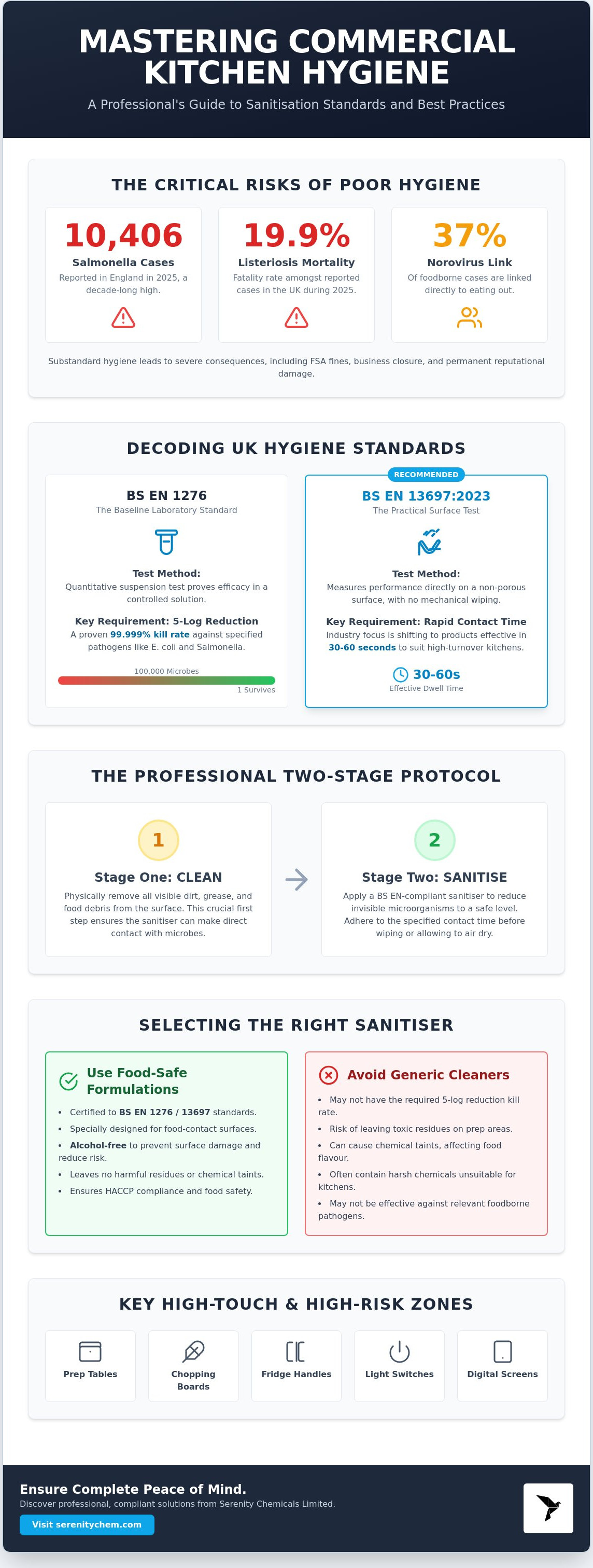
Pathogens such as E. coli, Salmonella, and Listeria are persistent threats in food preparation areas. In 2025, Salmonella cases in England reached a decade high of 10,406 reported incidents. Listeria is equally concerning; the UK Health Security Agency reported a 19.9% mortality rate amongst listeriosis cases that same year. These bacteria thrive in the presence of moisture and organic matter. Without a rigorous sanitisation protocol, cross-contamination becomes an inevitability rather than a risk. This is why professional kitchens must move beyond simple cleaning to true microbial control.
There is a fundamental difference between a surface being "clean" and being "sanitised." Cleaning is the physical removal of visible dirt, grease, and food debris. Sanitising is the process of reducing the number of microorganisms to a safe level. This requires the application of specific types of disinfectants that are formulated to work on non-porous materials like stainless steel without leaving harmful residues or chemical taints. The choice of agent depends heavily on the surface material; non-porous surfaces allow for rapid chemical action, whereas porous materials might require different contact times to be effective.
The Consequences of Substandard Surface Hygiene
The legal implications of poor hygiene are severe. A low Food Standards Agency (FSA) rating can lead to heavy fines or immediate business closure. Beyond the law, the reputational damage from a single outbreak is often permanent. Research suggests that 37% of foodborne norovirus cases are linked to eating out. Conversely, a kitchen that prioritises hygiene often sees improved operational efficiency. When staff work in a disciplined, clean environment, morale improves and the workflow becomes more methodical and professional.
Identifying Key High-Touch Hard Surfaces
Identifying every potential bacteria reservoir is vital for a complete protocol. Stainless steel preparation tables are the industry standard, but they can still harbour biofilms if not treated with the correct sanitising commercial kitchen hard surfaces protocol. Food-grade plastics and chopping boards are also high-risk areas. Knife scars in plastic boards create deep channels where bacteria can hide from standard surface wipes. Finally, don't overlook "touchpoints" like fridge handles, light switches, and digital order screens. These surfaces are handled constantly throughout a shift and are primary vectors for cross-contamination.
Understanding UK Standards: BS EN 1276 and BS EN 13697 Explained
Compliance in a professional kitchen isn't just about maintaining a clean appearance; it's about verifying that your chemical solutions meet rigorous laboratory benchmarks. BS EN 1276 is the UK standard for chemical disinfectants used in food and industrial areas. This standard uses a quantitative suspension test to prove that a product can achieve a 99.999% kill rate, also known as a 5-log reduction, against specific bacteria such as E. coli, Salmonella, and Listeria. In practical terms, this means that for every 100,000 microbes present on a surface, only one survives after the chemical is applied correctly.
Whilst BS EN 1276 is the baseline, BS EN 13697:2023 provides a more demanding evaluation for sanitising commercial kitchen hard surfaces. This standard tests the chemical's efficacy directly on a non-porous surface without any mechanical scrubbing or agitation. It reflects the real-world reality where a sanitiser is sprayed onto a prep table and left to work. As we move through 2026, the industry is increasingly prioritising products with faster contact times. High-turnover kitchens no longer have the luxury of five-minute dwell times; they require solutions that achieve compliance in 30 to 60 seconds to maintain safety without interrupting the pace of service.
Detergents vs Disinfectants vs Sanitisers
It's vital to distinguish between these three categories to ensure your protocol is effective. Detergents are designed to break down grease, fats, and organic matter; they clean the surface but don't kill bacteria. Disinfectants are formulated to reduce pathogens to a safe level but often lack the cleaning power to cut through heavy grime. Sanitisers act as a hybrid solution, specifically engineered for food-contact areas. They combine the cleaning properties of a detergent with the microbial kill rate of a disinfectant, making them the most efficient choice for sanitising commercial kitchen hard surfaces during a busy shift.
How to Read a Chemical Efficacy Label
When reviewing your inventory, look for the specific EN codes on the bottle. These codes are your guarantee that the product has been independently verified to meet the BS EN 1276 and BS EN 13697 standards. Pay close attention to the stated contact time. If a label requires a five-minute dwell time but your staff wipe it off after thirty seconds, the surface isn't legally or biologically sanitised. Selecting a product with a shorter contact time ensures that your safety standards are realistic and achievable for your team. If you're unsure which standard applies to your specific setup, you can always speak with our technical team for tailored guidance on chemical selection.
The Two-Stage Cleaning Process for Professional Food Preparation Areas
A common error in high-pressure kitchens is the assumption that a quick spray and wipe is sufficient for safety. It isn't. You cannot effectively disinfect a surface that still carries physical soil. Bacteria often shelter beneath microscopic layers of fats, proteins, and food debris. If these aren't removed first, your sanitising agent may never reach the pathogens it's designed to kill. This is why sanitising commercial kitchen hard surfaces must always be a disciplined, two-stage process.
Stage 1 is the physical cleaning phase. This involves using a detergent or degreaser to break down organic matter and lift it away from the surface. Once the area is visibly clean and free of grease, you move to Stage 2. This is the critical application of a food-safe sanitiser to eliminate the remaining invisible microbes. Patience is a prerequisite here. You must respect the "contact time" stated on the chemical label. If a product requires 60 seconds to work and you wipe it off in ten, your kitchen remains at risk. Choosing between rinse and no-rinse formulations depends on your specific workflow; no-rinse options are particularly efficient for prep tables that need to be back in service immediately.
Implementing a Colour-Coded Hygiene System
Standardising your cleaning equipment is a simple yet powerful way to prevent cross-contamination. By using blue cloths for general food prep and yellow for high-risk areas, such as raw poultry stations, you create a visual barrier against human error. This system ensures that bacteria from raw ingredients aren't inadvertently transferred to ready-to-eat meals. This method is a core component of Food Standards Agency guidance on effective cleaning. Robust staff training ensures every team member understands the colour hierarchy, making it an instinctive part of their daily routine.
Optimising Your "Clean-as-You-Go" Workflow
A disciplined "clean-as-you-go" policy prevents the build-up of grime that makes deep cleaning so difficult. Managing spills immediately stops bacterial growth and eliminates common slip hazards. Integrating a professional food safe sanitiser into this workflow allows for rapid, compliant turnarounds between tasks. By maintaining the integrity of each station during service, you protect your customers and ensure a much smoother close-down at the end of the shift. It's about working smarter to keep standards high whilst the pressure is on.
Selecting the Right Chemicals: Food-Safe vs Industrial Degreasers
Many operators look for a single bottle to solve every problem. This is a mistake. Specialised formulations outperform multi-purpose sprays because they target specific molecular structures, whether it's polymerised oils or microbial biofilms. Using the correct agent for sanitising commercial kitchen hard surfaces ensures that you aren't just moving dirt around, but actually neutralising threats without damaging your equipment. A "universal" cleaner often fails to meet the high bactericidal standards required for food-contact areas, leaving your kitchen vulnerable despite a clean appearance.
In a commercial kitchen, heat and naked flames are constant. Traditional alcohol-based sanitisers present a genuine flammability risk that is often overlooked in high-pressure environments. Alcohol-free sanitisers provide a safer alternative that is non-flammable and far kinder to the skin of your kitchen team. This reduces the risk of contact dermatitis, a common issue amongst staff who must wash and sanitise their hands frequently throughout a shift. Protecting your team's health is just as vital as protecting your customers from pathogens.
You must also consider the sensory impact of your chemicals. A professional sanitiser should be completely taint-free to ensure it doesn't alter the delicate flavour profile of your dishes. Regarding application, you have a choice between Ready-to-Use (RTU) bottles for convenience and concentrates for cost-efficiency. Concentrates reduce plastic waste and storage requirements, provided your team is trained in accurate dilution to maintain the efficacy required for sanitising commercial kitchen hard surfaces correctly.
The Science of Degreasing Hard Surfaces
Breaking down carbonised grease requires surfactants that can lower surface tension and lift heavy oils. Knowing when to use a commercial multi surface cleaner versus a heavy-duty degreaser is vital for protecting your investment. Highly acidic or alkaline industrial cleaners can pit and corrode stainless steel over time, leading to permanent damage. A balanced approach ensures surfaces are stripped of grease without compromising the material's integrity.
Ethical and Sustainable Chemical Sourcing
In 2026, ethical sourcing is a core business value. Choosing cruelty-free and vegan formulations reflects a principled approach to procurement that resonates with modern consumers. Working with a cleaning products manufacturer UK based allows you to verify these claims and reduce your carbon footprint. Bulk buying and refillable systems further support your sustainability goals by significantly lowering plastic waste and operational costs. If you're looking to refine your chemical inventory for better safety and efficiency, contact our specialists for a technical site audit.
Establishing a Robust Kitchen Hygiene Schedule with Serenity Chemicals Limited
Transitioning from understanding standards to daily implementation requires a structured approach. A robust schedule ensures that no area is overlooked and that sanitising commercial kitchen hard surfaces becomes a seamless part of the operational rhythm. Start by auditing your kitchen to identify every hard surface that requires a specific protocol. This includes obvious preparation areas and often forgotten zones like the internal seals of refrigeration units or the undersides of gantries. By mapping these out, you create a comprehensive hygiene blueprint that leaves no room for ambiguity or human error during a busy shift.
Management must turn these hygiene protocols into measurable Key Performance Indicators (KPIs). Assigning specific zones to individual team members fosters accountability and pride in the workspace. Compliance also extends to the Control of Substances Hazardous to Health (COSHH) regulations. It's essential that every chemical provided by Serenity Chemicals Limited has an easily accessible Safety Data Sheet (SDS). This protects your staff and ensures that, in the event of an inspection, you can demonstrate a principled commitment to safety and documentation. The "Serenity Standard" simplifies this by providing clear, compliant solutions like our Serenity Kitchen Sanitiser, which is specifically engineered to meet professional requirements whilst remaining user-friendly for your team.
Creating Your Daily and Weekly Checklists
Consistency is the only way to manage microbial risks effectively. Your schedule should be divided into clear temporal blocks to ensure thoroughness. Daily tasks should focus on high-frequency touchpoints; use Serenity Hard Surface Sanitiser on prep tables, handles, and digital screens. Weekly deep cleans should involve degreasing extractors and ovens using Serenity Heavy Duty Degreaser. Pull out mobile equipment to clean the hard surfaces behind them that are often missed. Monthly audits ensure that every surface remains in good condition and that stock levels for your Serenity Chemicals Limited products are maintained to avoid any lapse in hygiene standards.
Training and Verification for Long-Term Success
A schedule is only as good as its execution. Verifying cleanliness through visual inspection checklists or ATP swabs provides tangible proof that your sanitising commercial kitchen hard surfaces protocol is working. Continuous professional development is also vital; keeping your staff updated on 2026 hygiene regulations ensures they understand the "why" behind the "how." Serenity Chemicals Limited is committed to providing the technical support needed to foster a culture of safety that protects your brand's integrity. To ensure your team has the right tools for every task, discover our full professional cleaning chemicals list to equip your kitchen for total compliance.
Elevating Your Kitchen Hygiene Standards
Mastering kitchen hygiene isn't achieved by chance. It requires a methodical commitment to the two-stage cleaning process and a precise understanding of the regulatory landscape. By aligning your protocols with the latest UK standards, you transform a daily chore into a robust defence against foodborne pathogens. This disciplined approach ensures that your facility remains compliant whilst protecting the reputation you've worked hard to build.
Maintaining the highest levels of safety whilst sanitising commercial kitchen hard surfaces provides the essential foundation for operational success and consumer trust. Our professional range is formulated to exceed BS EN 1276 standards and is manufactured in the UK with a focus on ethical, alcohol-free safety. We are proud to be trusted by commercial catering environments across the United Kingdom to deliver results that don't compromise on well-being or efficacy.
If you're ready to simplify your compliance and provide your team with the most effective tools for the job, we invite you to View the Serenity Kitchen Sanitiser Range. Take the first step toward a safer, more efficient kitchen environment today.
Frequently Asked Questions
What is the difference between BS EN 1276 and BS EN 13697?
BS EN 1276 evaluates bactericidal activity in a liquid suspension, whereas BS EN 13697:2023 tests efficacy directly on a non-porous surface without mechanical action. The surface test is generally considered more representative of real-world kitchen conditions where chemicals are sprayed and left to dwell. Both standards are essential benchmarks for products used in sanitising commercial kitchen hard surfaces to ensure they meet professional safety requirements.
Can I use the same sanitiser for food-contact surfaces and floor cleaning?
Whilst some multi-purpose sanitisers are safe for both, it's more efficient to use specialised formulations for different areas. Serenity Kitchen Sanitiser is specifically designed for food-contact areas, whereas Serenity Floor Cleaner is better suited for removing the heavy grease and debris found on kitchen floors. Using the correct product for each surface prevents cross-contamination and ensures that floor-specific grime is effectively neutralised without wasting high-grade kitchen sanitiser.
How long should I leave a sanitiser on a surface before wiping it off?
You must follow the specific contact time stated on the product label, which typically ranges from 30 seconds to 5 minutes. If you wipe the product off too early, it won't achieve the required 99.999% kill rate. Modern professional formulations often prioritise faster contact times of 30 to 60 seconds to accommodate the high-turnover nature of busy commercial environments.
Are alcohol-free sanitisers as effective as alcohol-based ones in a kitchen?
Yes, alcohol-free sanitisers are just as effective, provided they carry the BS EN 1276 or BS EN 13697 certification. In a kitchen environment, they offer significant safety benefits as they are non-flammable and non-drying on the skin. They provide a reliable solution for sanitising commercial kitchen hard surfaces without the fire risks associated with traditional alcohol-based sprays.
Do I need to rinse a surface after using a "food-safe" sanitiser?
Rinsing requirements depend entirely on the specific product's formulation and the instructions provided by the manufacturer. Many professional sanitisers are "no-rinse," meaning they can be left to air-dry or wiped with a clean cloth without leaving harmful residues. Always check the label to ensure that no chemical taints affect the flavour or safety of your food.
How often should I deep-clean the hard surfaces in my commercial kitchen?
High-touch preparation surfaces must be cleaned and sanitised after every task or at least every four hours during service. A more intensive deep clean of extractors, ovens, and areas behind heavy equipment should be scheduled weekly. Monthly audits ensure that every hard surface remains in good condition and that your hygiene protocols are being followed consistently by all staff.
Is it safe to use industrial degreasers on food preparation tables?
You should only use degreasers on food preparation tables if they are specifically labelled as food-safe and non-tainting. Heavy-duty industrial degreasers can be highly corrosive and may pit stainless steel, creating microscopic traps for bacteria. For prep surfaces, use a balanced product like Serenity Multi-Surface Cleaner followed by a dedicated food-safe sanitiser to ensure total safety.
How can I tell if a cleaning product is HACCP compliant?
HACCP compliance is verified by checking for specific British Standards, such as BS EN 1276, and ensuring the product is suitable for food-contact areas. Look for clear labelling that guarantees a 5-log reduction in pathogens and a lack of chemical taints. A reputable manufacturer will always provide access to Safety Data Sheets (SDS) to support your HACCP documentation and risk assessments.

Hand Sanitiser for Frequent Use: Professional UK Guide 2026
The very product you use to protect your health might be the primary cause of your skin's deterioration. While alcohol-based ...

Food Safe Antibacterial Spray UK: The Professional 2026 Hygiene Guide
Using the wrong disinfectant in a commercial kitchen isn't just a minor oversight; it's a direct threat to your Food Hygiene ...